Uzbekistan's Wild Tulip Season: Where the World's Original Tulips Actually Come From
· 9 min read · Nature
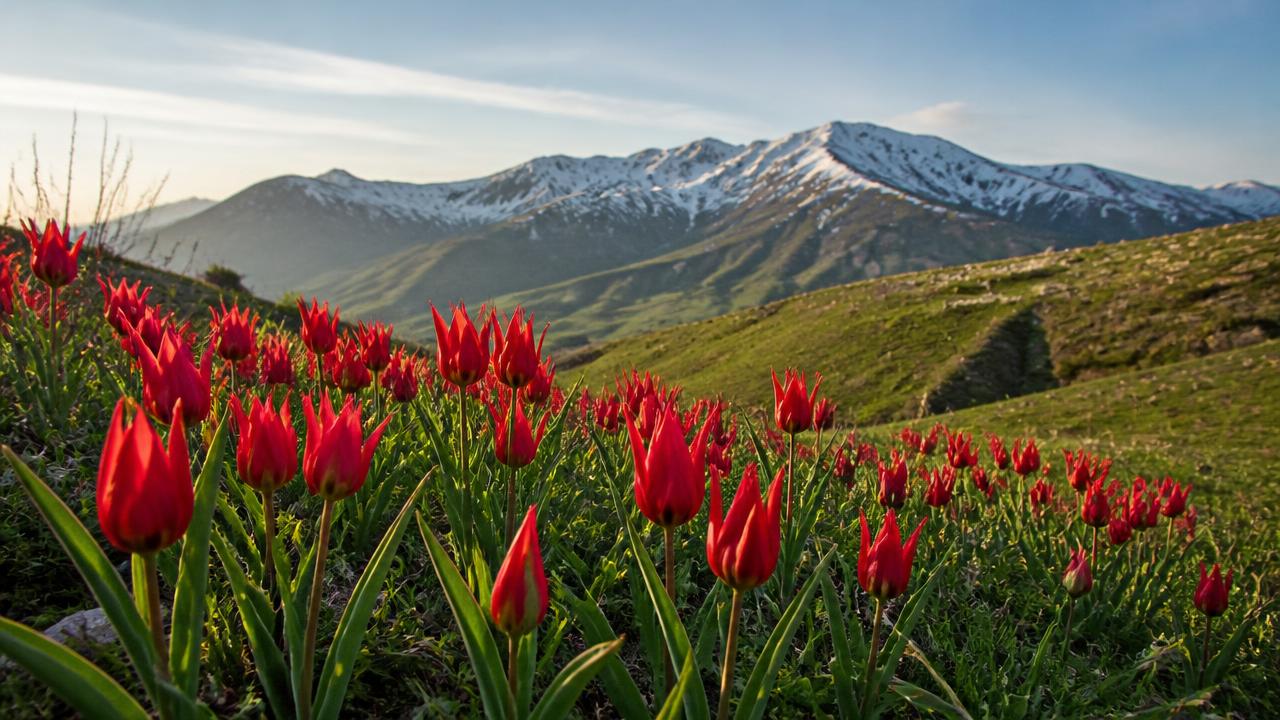
The tulip is the national flower of the Netherlands and the emblem of Turkish gardens — but the wild ancestors of every garden tulip grew, and still grow, on the mountain slopes of Central Asia. In spring you can walk through them.
Almost every visitor plans Uzbekistan around blue domes. Almost nobody plans it around flowers, which is why the country's most quietly spectacular seasonal sight goes unseen: for a few weeks each spring the foothills turn red, yellow and cream with wild tulips growing where nobody planted them. Central Asia — the Tien Shan and Pamir-Alay ranges that fold into eastern and southern Uzbekistan — is the genuine heartland of the genus Tulipa. The Dutch bulb industry is a downstream story.
The history in one paragraph
Wild tulips spread across the mountains of Central Asia long before anyone cultivated them. They were prized in Persian and Timurid gardens, travelled west into Ottoman horticulture, and reached the Netherlands in the 16th century, where selective breeding and the speculative frenzy remembered as tulip mania turned a mountain wildflower into a global commodity. Species carrying Central Asian names — Tulipa greigii, Tulipa kaufmanniana and others collected in the region in the 19th century — sit in the ancestry of countless modern garden varieties.
When they bloom
Wild tulip season is short and altitude-driven. As a rule of thumb, the lowest foothills go first and the high slopes go last, so the bloom climbs the mountain over several weeks rather than happening everywhere at once.
- Late March: the lowest, warmest foothills and the earliest species, overlapping with Navruz.
- April: the reliable core of the season in the mid-altitude foothills — the weeks most worth planning around.
- May: higher meadows and later species, as the valleys below have already gone to seed.
- Any given hillside holds peak colour for roughly one to two weeks, and a hot dry spring shortens that window.
Why the date moves every year
Bloom timing depends on winter snowpack and spring temperature, not the calendar. A warm February can pull the season forward by two weeks; a cold, wet April can hold it back. If tulips are the reason for your trip, keep the dates flexible and ask locally on arrival rather than trusting last year's photos.
Where to look
- The Western Tien Shan foothills near Tashkent — the Chimgan, Beldersay and Charvak area is the easiest day trip from the capital, and the slopes above the road hold spring flowers before the summer crowds arrive.
- The Nurata mountains — dry, rolling and thinly grazed, with mountain villages set up for homestays; combine flowers with a stay rather than a drive.
- Zaamin National Park in the Jizzakh region — higher, cooler and later in the season, with juniper forest and proper hiking.
- Surxondaryo and the Boysun mountains in the far south — earlier, hotter and less visited, and the region's spring festival season overlaps with the bloom.
- Botanical collections in Tashkent for a guaranteed, no-hiking version if your dates do not line up with the wild season.
How to see them without wrecking them
Several Central Asian tulip species are rare, narrowly distributed and legally protected, and the two things that hurt them most are bulb collecting and trampling by people chasing a photograph. The etiquette is simple and not optional.
- Do not dig bulbs. Beyond the conservation problem, taking plant material out of the country creates a customs problem.
- Do not pick the flowers. A picked wild tulip is one that never sets seed.
- Stay on existing paths and shepherd tracks; walk around a patch rather than through it for a closer shot.
- Photograph from a low angle at the edge of a stand instead of standing in the middle of one.
- Ask before crossing what looks like open hillside — most of it is grazing land somebody depends on.
Practical notes for a spring flower trip
- Mountain spring weather is genuinely changeable: warm sun, cold wind and sudden rain in one afternoon. Layers and real shoes, not city trainers.
- Early morning and late afternoon light is far kinder to red flowers than midday glare.
- Roads to higher trailheads may still hold snow or mud in early spring.
- Spring is also the greenest, most comfortable time to be in Uzbekistan generally — a flower trip pairs naturally with the cities, since the summer heat has not arrived yet.
Bloom timing varies year to year and protected-species rules apply in national parks; check locally before travelling. For the wider seasonal picture, see /blog/best-time-to-visit-uzbekistan, and for mountain logistics see /blog/chimgan-charvak-mountains-lake-guide-2026