UPI Is Coming to Uzbekistan (2026): What the India–Uzbekistan Payments Deal Actually Means When You Are Standing at a Bazaar Stall
· 10 min read · Money
Uzbekistan is joining the small club of countries accepting UPI. Useful — eventually. Here is what is agreed, what is not live yet, and exactly how to pay for things in Uzbekistan in the meantime.
In the same week that Uzbekistan announced 30-day visa-free entry for Indian citizens, a second, quieter announcement landed: Uzbekistan is set to accept India's Unified Payments Interface under a new partnership, joining the small group of countries that have adopted the platform outside India. For Indian travellers this is potentially the most useful bilateral development of the year — but only once it is switched on, and that is worth being precise about.
What has been agreed
The agreement is to enable UPI acceptance in Uzbekistan, reported around 1 September 2026 as part of the broader India–Uzbekistan package that also produced the visa waiver, a 2026–2028 tourism cooperation programme and new air routes. UPI internationalisation typically works through the domestic card and QR switch of the host country: Indian users scan a local merchant QR with their existing UPI app, and settlement happens between the two national payment operators. Uzbekistan already has the infrastructure this needs — a dense QR culture and two national card schemes.
What has not happened yet
Signing a partnership is not the same as a live merchant network. Elsewhere, UPI acceptance has rolled out gradually: airports and large retail first, then hotels, then general merchants, with plenty of stalls never joining at all. Assume that during 2026 you cannot rely on UPI in Uzbekistan for anything, treat any acceptance you find as a bonus, and plan your money the way every other foreign traveller has to.
How payment actually works in Uzbekistan right now
Uzbekistan is a two-layer payments country and the layers barely touch. Layer one is the domestic system: Humo and Uzcard cards, and the Click and Payme apps built on top of them. This is what locals use, it works everywhere from a supermarket to a taxi to a market stall, and it is almost entirely closed to foreign cards. Layer two is the international system: Visa and Mastercard, accepted at hotels, airlines, modern supermarkets, chain restaurants and larger shops in the big cities — and nowhere else.
The practical consequences
- Carry more cash than you would in Europe or the Gulf. Soum in small denominations for bazaars, taxis, entrance fees and neighbourhood cafés.
- ATMs that accept foreign cards exist in Tashkent, Samarkand, Bukhara and Khiva, cluster around banks and hotels, and thin out fast elsewhere. Withdraw before leaving a big city.
- Some ATMs dispense US dollars rather than soum. Both are useful; dollars are easy to exchange at bank counters at the official rate.
- Bring clean, untorn US dollar or euro notes to exchange. Damaged notes get refused or discounted.
- Do not rely on your phone's tap-to-pay. Contactless terminals exist but coverage is patchy and offline terminals are common.
- Keep exchange receipts if you change large amounts; they occasionally matter at departure.
The QR habit that makes UPI plausible here
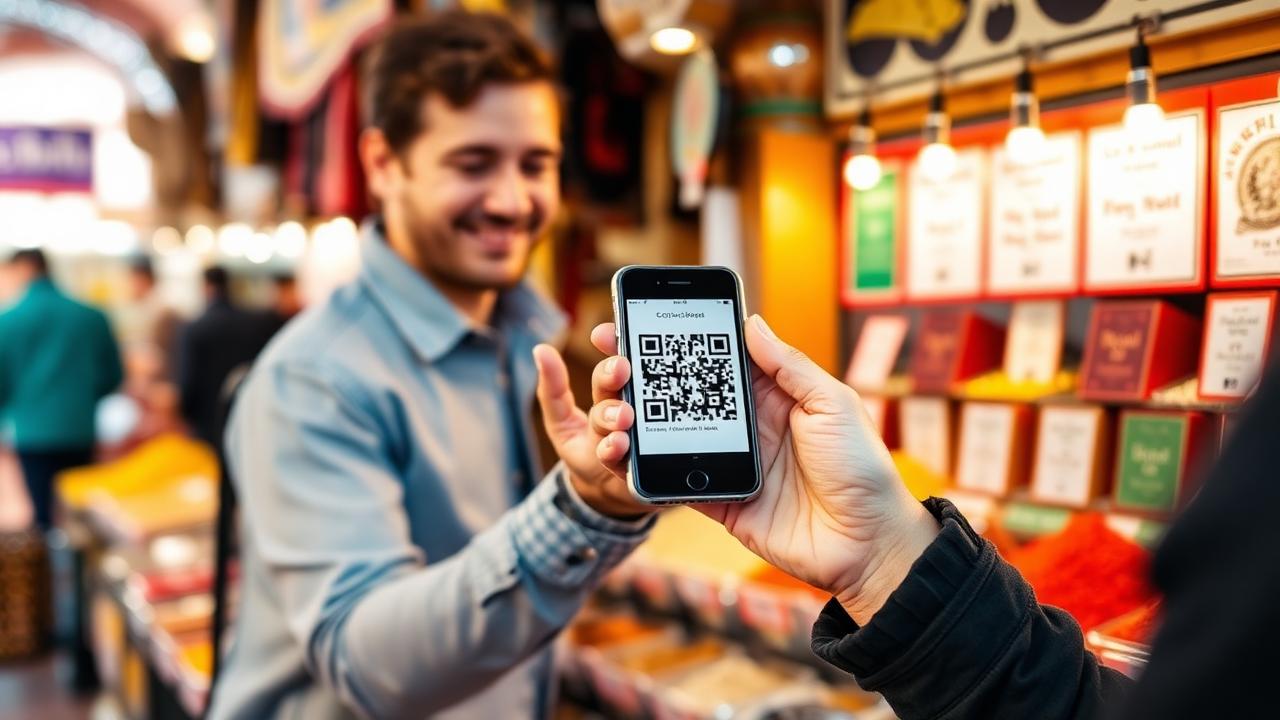
Walk into any Uzbek café and you will see a printed QR code taped to the counter. Domestic payment apps have made scan-to-pay completely normal across every income level — market traders, taxi drivers, roadside melon sellers. That cultural groundwork is exactly why a UPI tie-up is technically realistic rather than aspirational: the merchants already have codes, the switch is the missing piece. When it goes live, adoption could be fast in a way it would not be in a card-first country.
For long-stay visitors: get a local card
If you are staying more than a few weeks, opening a local account and getting a Humo or Uzcard is transformative. It requires a PINFL — the national identification number — and registration, and several banks now handle foreigners routinely. Once you have one, Click or Payme turn every utility bill, taxi, delivery and market purchase into a two-tap operation, and the exchange-rate friction of living on a foreign card disappears.
Budgeting expectations in 2026
Uzbekistan is still inexpensive by European or Gulf standards but is no longer the bargain it was five years ago, and the exchange rate has moved. Independent travellers commonly run on a modest daily budget covering a guesthouse, three meals, intercity train tickets and entrance fees, with plenty of room to spend more on private drivers and boutique courtyard hotels. Trains and museums are cheap; imported goods, international-standard hotels and anything involving a car with a driver are not.
What to do this trip
Bring dollars to exchange, keep a Visa or Mastercard for hotels and flights, download a taxi app that accepts cash, and check UPI acceptance opportunistically at airports and big-city retail rather than counting on it. If the rollout follows the pattern of other countries, by the time the visa-free regime has had a full season to work, scanning a QR at a Tashkent café with an Indian phone will be ordinary. It is not ordinary yet.