Renting a Car in Uzbekistan (2026): Self-Drive Rules, Police Checkpoints and What It Really Costs
· 11 min read · Practical
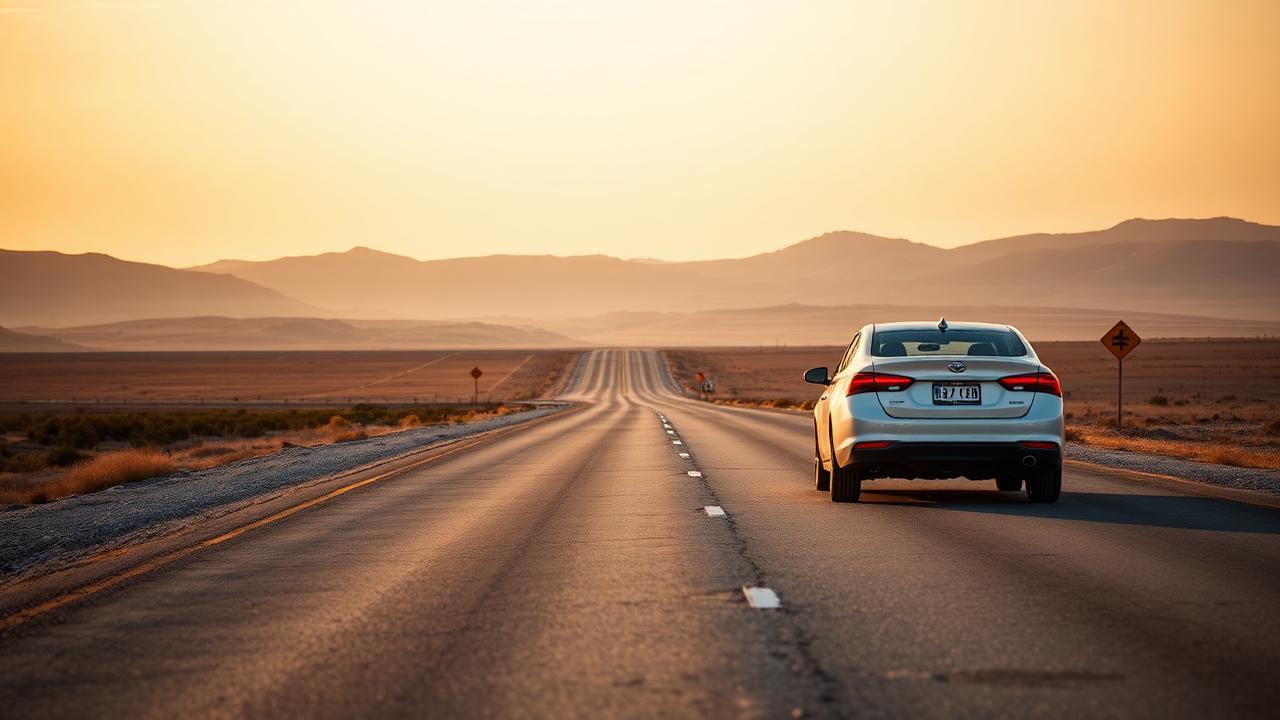
Almost every guide tells you to take the train. That is good advice for the Silk Road triangle and terrible advice for everywhere else. Here is what self-driving Uzbekistan actually involves in 2026.
Uzbekistan is one of the few countries in Central Asia where renting a car is genuinely straightforward for a foreign visitor, and one where most travellers never bother. The Afrosiyob train covers Tashkent–Samarkand–Bukhara–Khiva so well that a car looks pointless. It is pointless — until you want the Nuratau villages, the Fergana Valley backroads, Zaamin, Aydarkul, or a mountain road that no timetable serves. This guide covers the paperwork, the money and the road habits, based on how driving actually works here in 2026.
Can you legally drive as a tourist?
Yes, on a foreign licence, provided it is accompanied by an International Driving Permit if your licence is not in Latin script. An IDP is cheap, takes minutes to obtain at home, and is impossible to obtain once you have landed — get it before you fly. Rental companies will ask for your passport, your visa or entry stamp, your licence and the IDP, and most set a minimum age of 21 to 23 with at least two years of driving experience.
Documents to keep in the car
- Passport, or at minimum a clear photo of the passport page and entry stamp.
- Driving licence plus the International Driving Permit.
- The rental agreement and the vehicle's technical passport, which the company supplies.
- Proof of insurance — check that third-party cover is included rather than assumed.
What it costs in 2026
A small locally-built Chevrolet — Cobalt, Nexia or Lacetti — rents from roughly 30 to 45 US dollars a day from a Tashkent agency, less on weekly rates. A Captiva or Equinox class SUV runs 60 to 90. Deposits are the part that surprises people: expect a hold of 200 to 500 dollars, sometimes taken in cash, and read the fuel and mileage clauses before signing. Many local agencies still cap daily kilometres, which matters enormously if you are driving Tashkent to Khiva.
Driver-included is a real option
Hiring a car with a driver costs surprisingly little more than self-drive once you factor in fuel, and it removes the checkpoint conversations, the parking arguments and the navigation. For a single long transfer such as Bukhara to Khiva across the Kyzylkum, a driver is usually the better purchase. Self-drive earns its keep on multi-day loops where you stop constantly.
Fuel: methane, propane and petrol
A large share of Uzbek cars run on compressed methane or liquefied propane rather than petrol, which is why you will see filling stations where every driver gets out of the car during refuelling — that is a safety rule, not a local quirk. Rental cars are usually petrol. Ai-92 is the standard grade and is widely available; Ai-95 is patchier outside cities. Fill up before long desert stretches, and carry cash, because some rural stations still prefer it.
Police posts, speed cameras and what stops feel like
You will pass fixed police posts between regions. They are routine, usually polite, and often wave foreign plates through after a glance at documents. Speed enforcement in 2026 is overwhelmingly automated: the highway network is dense with cameras, and fines arrive against the vehicle, which means against your rental deposit. Limits are typically 70 km/h in built-up areas, 100 on main roads and 110 on parts of the Tashkent–Samarkand highway, but read the signs rather than trusting a rule of thumb.
- Blood alcohol limit is zero. There is no acceptable amount of drinking before driving.
- Seatbelts are mandatory in the front and increasingly enforced.
- Right turn on red is not permitted unless a separate green arrow says otherwise.
- Dashcams are extremely common and are useful evidence if anything goes wrong.
Driving culture, honestly
Tashkent traffic is fast, lane discipline is loose and merging is done by confidence rather than signalling. Outside the cities the roads empty dramatically and the main hazards become livestock, unlit tractors after dusk, and long unbroken straights that make it easy to drift over the limit. Avoid driving mountain roads at night, particularly the Kamchik Pass in winter, when the tunnel and pass sections can close without much notice.
Routes actually worth self-driving
- Tashkent to the Nuratau mountains and Aydarkul — village homestays and lake shore that no public transport reaches sensibly.
- The Fergana Valley loop: Kokand, Rishtan, Margilan, Chust, with a stop at the Kamchik Pass viewpoint.
- Samarkand to Shahrisabz over the Takhtakaracha Pass, which is a far better drive than the tunnel route.
- Tashkent to Chimgan, Charvak and Beldersay for a mountain day that a taxi will rush you through.
- Zaamin National Park, which is close to unreachable without your own wheels.
When not to bother
If your trip is the classic Tashkent–Samarkand–Bukhara–Khiva line, skip the car. The high-speed train is faster city-centre to city-centre, cheaper than fuel plus deposit, and the old towns are pedestrian zones where a car becomes a parking problem. Compare the options in our train guide: /blog/afrosiyob-high-speed-train-tashkent-samarkand-bukhara-khiva-2026-guide
Practical checklist before you drive away
- Photograph every panel of the car, the wheels, the windscreen and the fuel gauge before leaving the lot.
- Confirm in writing whether the deposit covers camera fines and how long the company holds it after return.
- Download offline maps — mobile coverage is good on main roads and thin in mountain valleys.
- Save the rental company's phone number and the emergency number 102 for police, 103 for ambulance.
- Keep small som notes for parking attendants, who are informal but universal.
Driven with a little caution, Uzbekistan is one of the more relaxing countries in the region to explore by car: fuel is cheap, roads between major cities are in good shape, and the empty stretches are genuinely beautiful. The mistake is renting for the wrong itinerary, not renting at all.