Choyxona Culture in Uzbekistan (2026): How Tea Actually Works, and the Etiquette Nobody Explains
· 10 min read · Culture
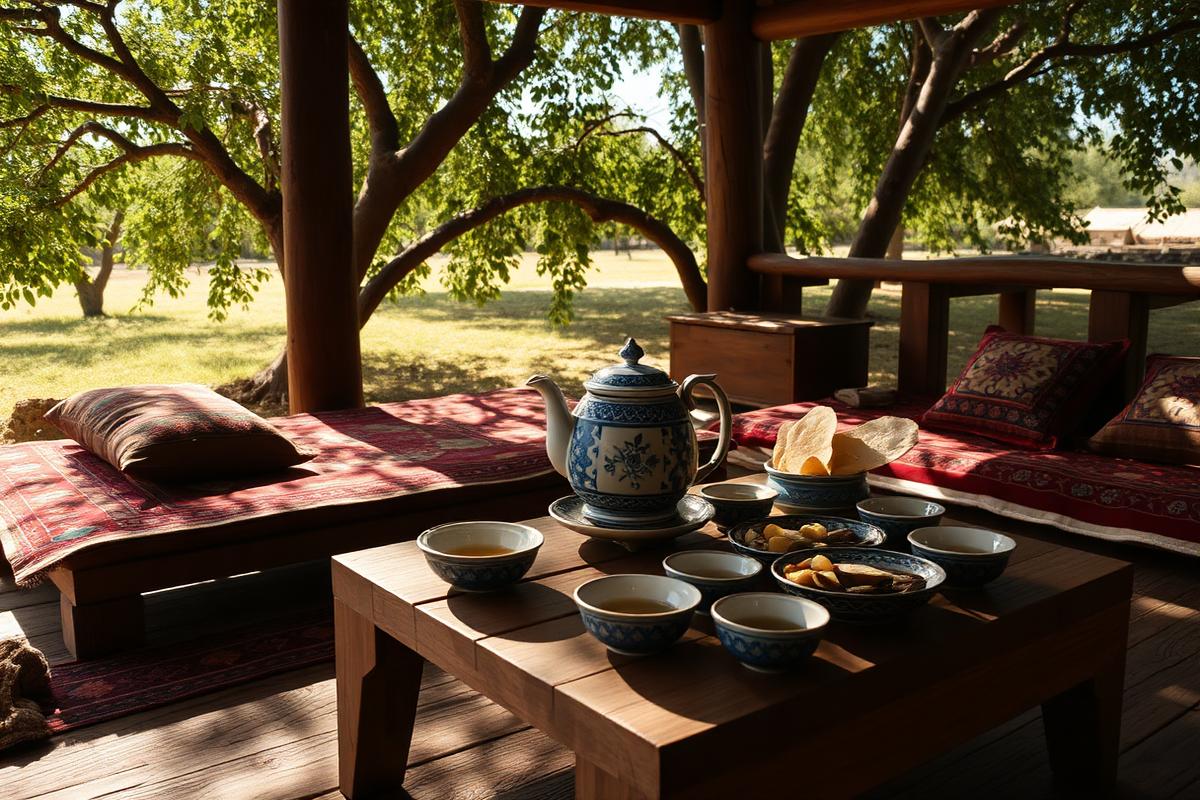
Tea in Uzbekistan is not a drink, it is a protocol. Here is what the three pours mean, why a full cup is a mild insult, who pours, and how to sit at a choyxona without getting anything wrong.
Almost every visitor to Uzbekistan is handed a bowl of tea within an hour of arriving — in a hotel lobby, a carpet shop, a family kitchen, a bazaar stall. Almost none of them are told what is happening. The pouring is not random, the small amount in your cup is not stinginess, and the person holding the teapot is not a waiter. Uzbek tea is a set of rules that locals learned as children and never think to explain. This guide explains them.
What a choyxona actually is
A choyxona (chaikhana in Russian usage) is a teahouse, but the translation undersells it. Historically it was the men's living room of the mahalla — the neighbourhood's news desk, job centre, dispute-resolution service and social club, usually beside a canal or under mulberry trees for shade. People came for hours, not minutes.
Physically, the classic choyxona is built around the so'ri (also written supa): a raised wooden platform, roughly bed-sized or bigger, covered with a rug and cushions, with a low table in the centre. You take off your shoes, climb up, and sit cross-legged or lean on a bolster. In 2026 you will find three broad versions:
- The surviving traditional choyxona — roadside, canal-side or in an old mahalla, mostly older men, low prices, tea and a plate of something.
- The restaurant choyxona — a full kitchen doing plov, shashlik, lagman and manti, with so'ri seating outside and normal tables inside. This is where most travellers end up, and it is entirely appropriate for families and mixed groups.
- The revival choyxona — designed, air-conditioned, ceramic-heavy Tashkent versions aimed at younger locals and visitors, often with speciality tea menus alongside the standard green.
The tea itself: what you will actually be served
- Kok choy — green tea. The default across most of the country, and the standard partner to fatty food like plov, precisely because it cuts grease.
- Qora choy — black tea. More common in Tashkent, and in some households the everyday choice; in Khorezm and parts of the north it is a strong preference.
- Tea with milk — in Khorezm you may be offered a milky, sometimes salted, tea closer to a Central Asian steppe style than to English tea.
- Herbal add-ins — mint, basil (rayhon), thyme, rose petals or a slice of lemon, often on request rather than by default.
Sugar is usually not stirred in. It arrives beside the tea as lump sugar, boiled sweets, halva, nabot (crystallised sugar) or simply as the dried apricots, raisins and nuts on the table. The local method is to hold something sweet in the mouth and drink the tea through it.
Why nobody adds milk to green tea
Outside Khorezm, asking for milk in green tea will get you a polite but genuinely confused look. Green tea here is treated as a digestive and a thirst-quencher, drunk hot even in 40°C summer heat because — as every Uzbek will tell you — hot tea cools you down better than cold water. They are not entirely wrong: the sweating response does more work than the cold drink does.
The three pours: qaymoq, moy, choy
This is the ritual that confuses visitors most. Before serving anyone, the host pours tea from the pot into a piyola (the small handleless bowl), then pours it straight back into the pot. Then again. Then a third time. Only after that does anyone get a drink.
There is a rhyme for it that most Uzbeks can recite: loy, moy, choy — or in the commonest version, the three pours are named qaymoq, moy and choy.
- First pour (loy, 'clay') — clears the pot's spout and settles the leaves; this tea is weak and cloudy.
- Second pour (moy, 'oil' or 'fat') — mixes and warms the brew evenly.
- Third pour (choy, 'tea') — the tea is now the right strength and temperature, and serving begins.
The practical function is real: it brews the pot evenly instead of leaving the top weak and the bottom bitter. The social function matters more — it is a visible signal that the host is taking care of you.
Why your cup is only a third full
The single most misread piece of Uzbek etiquette. Your piyola will arrive containing barely a third of its volume. This is not meanness. It is the opposite.
- A small pour stays hot, so you never drink lukewarm tea.
- It forces the host to refill you often — and each refill is a small renewed act of hospitality and a reason to keep talking.
- The unspoken saying is that a full cup means 'drink up and go'. Filling a guest's bowl to the brim can read as a hint that you want them to leave.
So if your bowl keeps getting topped up in tiny amounts, you are being honoured, not rationed. If someone fills it to the top, they are either not thinking about it or — very occasionally, and usually jokingly — telling you the evening is over.
Who pours
The youngest person present, or the host, pours for everyone. If you are the youngest at the table and the pot is near you, picking it up and serving others is the single fastest way to earn approval in an Uzbek household. Pour with the right hand, or with the right hand supported at the wrist or elbow by the left — the two-handed gesture is a mark of respect and shows up all over Uzbek daily life, from handing over money to giving a business card.
Choyxona etiquette: a practical checklist
- Take your shoes off before stepping onto the so'ri platform. Always. Socks with holes are the real risk here, not the rule itself.
- Wait to be shown where to sit. Seats away from the entrance are the places of honour and belong to elders and guests.
- Greet the table, especially older men, with 'Assalomu alaykum'. A hand on the heart with a slight nod works in every situation and needs no language.
- Accept the first cup. Refusing tea outright is the one genuinely rude move; taking it and sipping slowly is entirely fine.
- Use your right hand to give and receive the bowl.
- Do not put non (bread) upside down on the table, and do not throw bread away. Tear it by hand rather than cutting it at the table.
- Do not stick your feet out towards the food or towards other people while sitting on the platform — tuck them under or to the side.
- Expect to be fed. 'Just tea' frequently turns into bread, salad, dried fruit and then somebody ordering shashlik.
Women in choyxonas
In old-style, mahalla-corner teahouses the crowd is still mostly older men, and a lone woman would be conspicuous rather than unwelcome. In every restaurant-style choyxona, mixed and family groups are completely normal, and solo female travellers eat in them daily without issue. If a place looks like a men's card game with a samovar, it probably is; the one with a menu and families outside is the one you want.
How to pay, and what it costs
- A pot of green tea in a normal choyxona is very cheap — often a few thousand so'm, roughly the price of a bottle of water.
- Tea is usually charged per pot (choynak), not per cup, and the pot is refilled with hot water on request.
- Many places add a small service or bread charge; a plate of non and dried fruit appearing unasked is generally charged if eaten.
- Cards and QR payment via Payme, Click and Uzum work in city restaurants; take cash for roadside and rural teahouses.
- Tipping is not obligatory. Rounding up, or 5–10% at a sit-down restaurant, is generous.
Where to sit down for tea, city by city
- Tashkent — the classic experience is a garden or canal-side choyxona attached to a plov centre: eat at midday, then stay for tea. Chorsu bazaar's upper level also serves tea beside the food stalls.
- Samarkand — teahouses around the Registan and along the pedestrian streets are convenient but tourist-priced; walk ten minutes into the residential grid for local rates.
- Bukhara — the shaded platforms around Lyab-i Hauz, beside the pool, are the most photogenic tea in the country, especially in late afternoon.
- Khiva — inside the Itchan Kala walls, rooftop teahouses at sunset; expect black or milky tea more often than elsewhere.
- Fergana Valley — Rishtan, Margilan and Kokand still have working neighbourhood choyxonas where the tea is an excuse for conversation and the ceramics are locally made.
Ten minutes that change the trip
The reason to learn this is not trivia. Tea is the mechanism by which Uzbek hospitality actually operates: the invitation, the sitting, the pouring, the refilling and the not-leaving are one continuous social act. Visitors who understand the three pours, take the small cup as a compliment and pour for others get invited to things. Visitors who wave the tea away and check their phone do not.
For the food that goes with it, see the dishes guide: /blog/uzbek-food-guide-15-must-try-dishes — and for the wider rules of being a guest in an Uzbek home, see /blog/uzbek-hospitality-mehmon-guest-etiquette-guide-2026