How to Buy a Real Uzbek Carpet in 2026: Prices, Fakes & Best Workshops
· 12 min read · Shopping
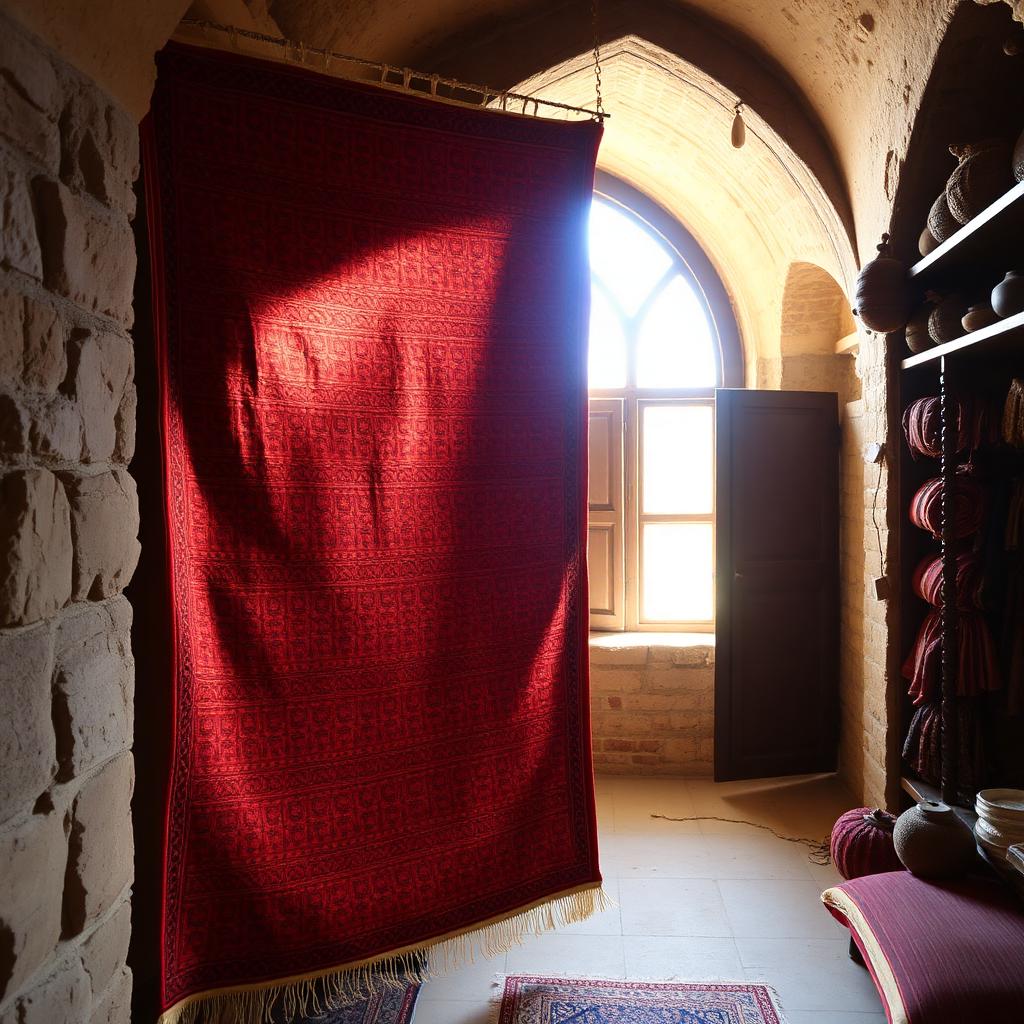
A real Bukhara rug is a 6-month project woven by two pairs of hands. A fake one is sprayed-on Chinese polyester. Here's exactly how to tell them apart, what to pay, and how to get yours home in 2026.
Uzbekistan is one of the last countries in the world where you can still watch a 2-meter handwoven carpet being made from scratch in front of you. By 2026 the craft is recovering after Soviet-era decline, and Bukhara, Khiva, and Samarkand each have small workshops producing real pieces. The problem is that 90% of what is sold in tourist bazaars is fake — machine-made in China or printed on cheap polyester. This guide tells you exactly how to spot the difference, where to buy real, and what to pay.
Uzbek carpets vs Turkmen carpets — the confusion
Most 'Bukhara carpets' sold in the West are actually Turkmen-style (the elephant-foot 'gul' pattern was originally a Turkmen tribal motif). For centuries Bukhara was the trading hub where Turkmen tribes brought their carpets to sell, so the city name stuck on the style. True Uzbek-made carpets do exist and have their own distinct traditions:
- Bukhara-style: red base, repeating octagonal guls, fine wool or silk.
- Khiva / Khorezm: bolder geometric patterns, thicker pile, regional motifs from the walled city.
- Samarkand: pomegranate and almond motifs, often silk warp on cotton.
- Fergana: tribal Uzbek and Kyrgyz crossover styles, kilim-like flatweaves.
Silk vs wool vs blend
All three are sold. Knowing what you actually want matters:
- Pure silk: lightest, finest knots (up to 1 million knots/m²), most expensive, ages beautifully. Best for wall hanging.
- Pure wool: heavier, lower knot count (200,000–400,000/m²), durable, best for floors.
- Silk-on-cotton: silk pile on cotton warp — common Bukhara style, mid-price.
- Silk-on-wool: silk pile on wool warp — Khiva specialty, very durable.
How to spot real vs fake (the 6 tests)
- Back-of-rug test: handwoven rugs have visible knots on the back, irregular and slightly different sizes. Machine-made has a perfectly flat gridded back, often with glued backing.
- Pattern match test: flip the rug — the pattern should be almost identical front and back on a handwoven piece. Printed/machine pieces have a blurry or invisible back pattern.
- Knot density: bend the rug and count knots in 1 cm². Real Bukhara has 30+ knots per cm². Tourist garbage has 5–10.
- Burn test (workshop will let you): pull a single fiber, burn it. Silk smells like burning hair, wool smells like burnt feathers, polyester smells like melting plastic and balls up.
- Fringe test: real handwoven fringes are continuations of the warp threads — they grow out of the rug. Fake fringes are sewn or glued on as a separate strip.
- Color test: real natural dyes have subtle 'abrash' (slight color variation across the rug). Synthetic dyes are perfectly uniform.
Vetted workshops worth visiting (2026)
Bukhara
- Caravan Restaurant & Silk Workshop (Lyabi-Hauz area) — small loom in back room, real silk Bukhara rugs, fixed prices, certificates included.
- Bukhara Silk Carpets (near Magoki-Attori mosque) — family workshop, no tourist markup, will weave custom designs in 4–6 months and ship.
Khiva
- Khiva Silk Carpet Workshop (Ichan Kala, near Kunya Ark) — UNESCO-supported, you can watch the entire silk-from-cocoon process, prices fair.
- Bibi-Khanym Carpet Center — multi-room workshop, kid-friendly tours.
Samarkand
- Samarkand-Bukhara Silk Carpets (between Registan and Bibi-Khanym) — biggest selection, but bigger tourist markup. Negotiate hard.
- Hudjum Silk Factory (small Samarkand branch) — mostly atlas silk fabric, but some carpet pieces.
2026 prices (you should pay)
- Small Bukhara wool rug (1m × 1.5m): $200–500
- Mid-size silk Bukhara (1.5m × 2m): $1,200–3,500
- Large premium silk (2m × 3m, 600,000+ knots/m²): $5,000–15,000
- Khiva silk-on-wool (1.5m × 2m): $800–2,500
- Tourist-bazaar fake 'Bukhara' (1.5m × 2m): $80–200 — don't buy it.
- Custom commission, full silk (delivered in 6 months): $3,500–12,000
Bargaining etiquette
- Workshops have largely fixed prices; small discounts (5–15%) possible for cash USD or larger pieces.
- Tourist-shop bargaining can knock 40–60% off opening prices — but the rugs are often fake anyway.
- Never insult a real handwoven rug or its weaver — start polite, walk away politely if price is high.
- Buying multiple pieces? Always ask for a 'family discount' on the second piece.
Shipping home — the practical guide
- Most reputable workshops will ship via DHL, EMS or Uzbekistan Post. Expect $80–250 to Europe/US for a small/medium rug.
- Get an export certificate from the workshop — for any rug older than 50 years, customs may require Ministry of Culture clearance.
- Declare the rug honestly at your home country customs — under-declaring can mean confiscation.
- Always insure the shipment. Always.
Quick answers
How much does a real Uzbek carpet cost in 2026?
Expect $200–500 for a small handwoven wool rug, $1,200–3,500 for a mid-size silk Bukhara (1.5m × 2m), and $5,000–15,000 for a large fine-knot silk piece. Anything advertised as a 'silk Bukhara' under about $300 is machine-made.
How can I tell a handmade carpet from a machine-made one in 60 seconds?
Turn it over. A handwoven rug shows individual, slightly uneven knots and the same pattern on the back; a machine-made rug has a flat gridded reverse, often with glue or fabric backing, and a blurry back pattern. Then check the fringe — real fringe is the warp itself, not a sewn-on strip.
Can I take a carpet out of Uzbekistan legally?
Yes. New carpets leave freely with the workshop's receipt and certificate. Anything that looks antique — roughly 50 years or older — needs an expert assessment and clearance from the culture authorities before export, and customs officers at Tashkent airport do check. Ask the seller to arrange the paperwork before you pay.
Is it cheaper in Bukhara, Khiva or Samarkand?
Bukhara has the best combination of price and choice. Khiva is fair but has a narrower range. Samarkand carries the biggest tourist markup — the same rug can be 20–40% more than in Bukhara.
How long does a custom carpet take?
Four to six months for a full-silk piece around 1.5m × 2m, longer for larger commissions. Pay a deposit of 30–50%, keep the written specification (size, knot count, dye type), and agree shipping cost in writing at the same time.
Sizes, and what actually fits at home
- 1m × 1.5m: wall hanging or bedside piece. Easiest to carry as hand luggage — a rolled silk rug of this size weighs 2–4 kg.
- 1.5m × 2m: the standard living-room rug and the most common workshop size. Ships in one roll.
- 2m × 3m: needs freight rather than courier for most destinations; get a quote before committing.
- Runners (0.8m × 3m): hallway pieces, often overlooked and better value per knot.
Caring for it once it's home
- Rotate the rug twice a year so sun fading and footfall stay even.
- Vacuum without the beater bar, in the direction of the pile, never against it.
- Blot spills, never rub. For silk, use cold water only and a professional cleaner for anything larger than a coin.
- Keep silk pieces out of direct midday sun — natural dyes fade faster than synthetic ones.
- Use a felt or rubber underlay on hard floors to stop the knots grinding.
Final word
A real Uzbek carpet is not a souvenir. It is six months of one or two women's lives, transferred to wool and silk, that you will own for the next century. Don't buy the $100 fake to take a fast photo. Either buy a real rug, even a small one, or buy nothing and take a great memory home instead. If you're shopping for textiles more broadly, our suzani buying guide (/blog/uzbek-suzani-embroidery-buying-guide-2026) covers the embroidery side of the same bazaars.