Tashkent TV Tower: The 375-Metre View Nobody Talks About (2026 Guide)
· 8 min read · City Guide
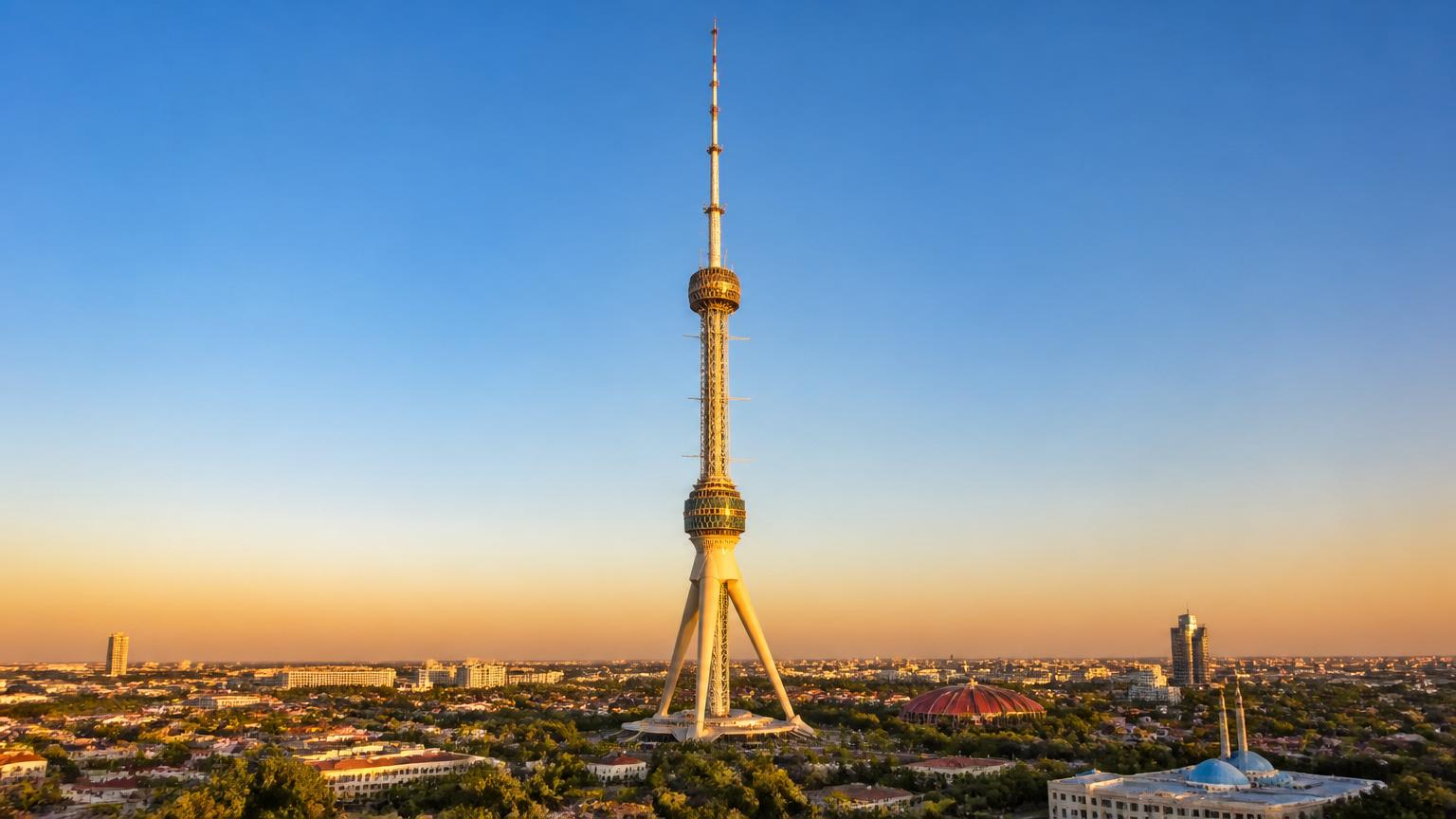
It is 375 metres tall, survived being built on one of the most active seismic zones on earth, has a rotating restaurant that completes a full turn every 60 minutes — and hardly any foreign tourist visits. Here is Tashkent's most underrated view.
The Tashkent Television Tower (Toshkent Teleminorasi, Ташкентская телебашня) is the tallest structure in Central Asia at 375 metres, and the 9th tallest self-supporting tower in the world. It was completed in 1985 after ten years of construction and was intentionally over-engineered to survive a magnitude-9 earthquake — a direct response to the 1966 Tashkent earthquake that flattened much of the city. In 2026 it remains an operational broadcast tower AND the single best panoramic view of Tashkent — from a design that looks like a Soviet spaceship crossed with a minaret. Almost every foreign visitor skips it. That is the point of this guide.
What is up there
- Lower observation deck at 97 m — glass windows all around, benches, panels explaining the Tashkent skyline in 4 languages.
- Upper observation deck at 220 m — same views but 40% smaller and with a section of glass floor added in 2023.
- Blue Hall (Koinot restaurant) at 105 m — non-revolving, Uzbek and European menu, best for lunch.
- Red Hall (Chigatoy restaurant) at 110 m — revolves 360° in 60 minutes, best for dinner. Windows on all sides, so a booth swap is unnecessary.
- Souvenir shop at ground level (skip it — everything is available in Chorsu for half the price).
2026 ticket prices and hours
- Observation deck ticket (lower 97 m only): 60,000 UZS foreigners (~$5), 30,000 UZS Uzbek citizens, 20,000 UZS children under 12.
- Combined ticket for both decks (97 m + 220 m): 100,000 UZS.
- Restaurant Koinot: 15,000 UZS 'entrance charge' waived if you spend more than 200,000 UZS on food. Mains 80,000–180,000 UZS.
- Restaurant Chigatoy (revolving): minimum spend 350,000 UZS per person, reservations essential 24 hours ahead.
- Open daily 10:00–22:00. Last tickets 21:00.
- Bring your passport — it is checked at security for foreigners.
Photography rules
Phones and normal cameras allowed on both decks free of charge. Tripods and professional lenses (over 200 mm) require a permit (150,000 UZS, buy at ticket office). Drones banned within a 3 km radius — this is enforced. No filming into the broadcast equipment areas. Windows have a slight blue tint; use custom white balance to correct.
Best time to go up
Sunset. Specifically, arrive 90 minutes before official sunset time, buy the combined ticket, do the 220 m deck first for the wide daylight view, then descend to Chigatoy for dinner and watch Tashkent turn on its lights as your table quietly rotates. In summer (June–August) that means arriving by 18:30 for a 20:00 sunset. In winter arrive by 15:30. Cloudy days can be beautiful — Tashkent's dust settles and the Tian Shan mountains 80 km east become visible on the horizon.
How to get there
- Metro: Bodomzor station (green Yunusobod line) — 800 m walk north, follow the tower, it is unmissable. Metro flat fare 2,000 UZS.
- Yandex Go from Amir Timur square: 25,000–40,000 UZS, 15 minutes.
- Free parking on-site for personal cars.
- Tour buses drop off at the main entrance on Amir Timur avenue.
The earthquake engineering story
In April 1966 a magnitude-5.1 earthquake destroyed 78,000 homes in central Tashkent and left 300,000 people homeless. When the tower was designed a decade later, Soviet engineer Nikita Nikitin (also the architect of Moscow's Ostankino tower) added a double-decoupled foundation on 8 metres of reinforced concrete pillars driven into loess bedrock, a tuned mass damper at 220 m, and a spiral tension-cable system through the shaft. Wind sway at the top is limited to 1.5 metres in a hurricane; earthquake sway is designed to reach 3 metres without structural damage. In the 2023 magnitude-4.7 quake felt in Tashkent, no damage was recorded — restaurants continued serving.
What you actually see from the top
- North: Chatkal mountains, the Charvak reservoir on a clear day.
- East: Amirsoy ski resort ridgeline and the wide Chirchik river valley.
- South: the flat Golodnaya steppe stretching toward Samarkand.
- West: the Tashkent City skyscraper cluster, the airport, and — on smog-free winter mornings — the outline of the Nurata range.
- Directly below: Ankhor canal, Japanese Garden, Alisher Navoi park.
Combine with these on the same evening
- Japanese Garden (10 min walk south) — sunset lanterns, quiet lake.
- Tashkent City Park — modern skyscrapers, fountain show 21:00 in summer.
- Minor Mosque — white marble, especially photogenic when lit.
- Broadway street (Sayilgoh) — souvenir stalls, buskers, best evening ice-cream in town.
Verdict
For $5–$10 and one hour, the Tashkent TV Tower gives you the widest, highest, cheapest panoramic view in Central Asia — from a piece of Soviet engineering that is genuinely world-class. Book the revolving restaurant for a special evening; do the deck alone for a quick sunset. Either way, it belongs on any 2-day Tashkent itinerary that pretends to be serious.