Tashkent's Giant Mosaics Are Finally Protected: The 2026 Guide to the Art Above Your Head
· 9 min read · Art & Architecture
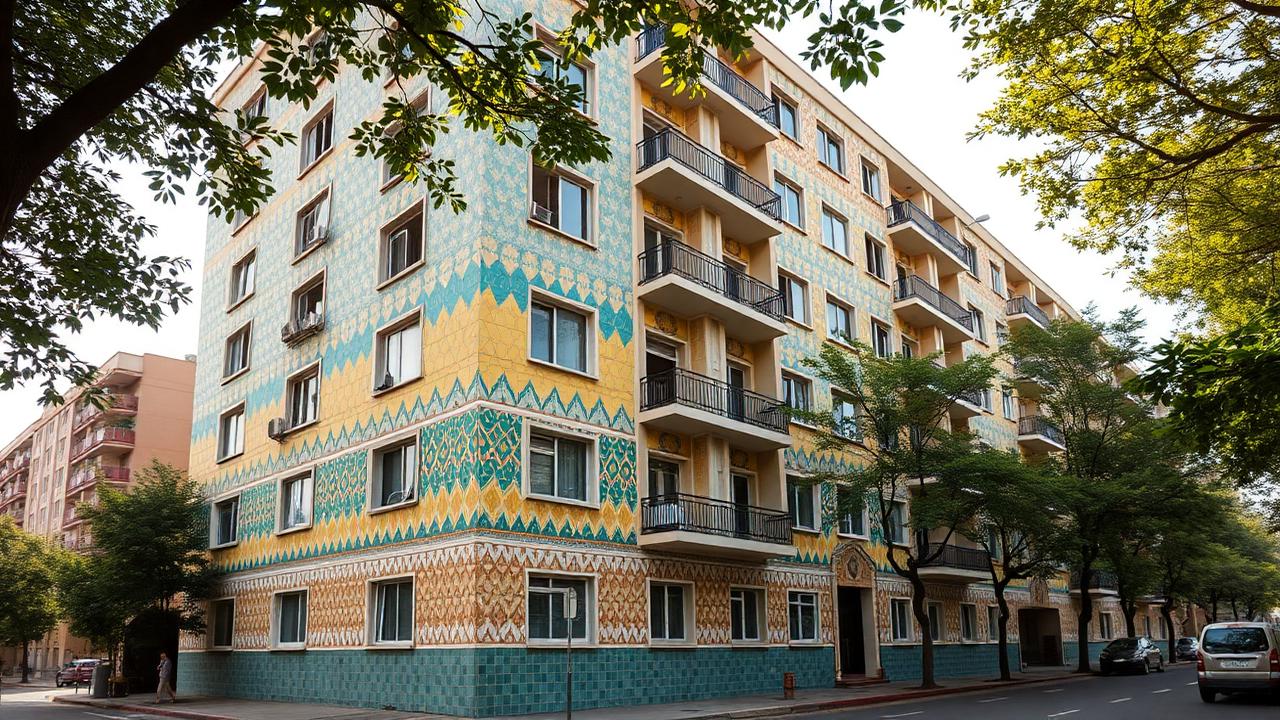
Hundreds of apartment blocks in Tashkent carry enormous ceramic patterns inspired by Uzbek textiles and mathematics. Long treated as background, the mosaics are now being documented and protected as part of the capital's identity.
Look up in Tashkent's residential districts and entire building ends become carpets: suns, stars, cotton bolls, rockets and repeating turquoise geometry assembled from ceramic tiles. These mosaics were integrated into mass housing after the 1966 earthquake, turning standardised concrete into something unmistakably local.
Why Tashkent has so many monumental mosaics
After the earthquake, architects and workers from across the Soviet Union rebuilt the capital at extraordinary speed. Standard apartment blocks solved the housing emergency but risked making every district look interchangeable. Artists used large facade mosaics, reliefs and patterned panels to connect modernist construction with Central Asian ornament.
The preservation turn
For decades these works had uncertain status. Renovation, advertising, insulation and demolition could damage them because they were treated as building surfaces rather than public art. Recent documentation and heritage measures have made the strongest examples more visible and harder to erase, while restoration projects have renewed public debate about authenticity and colour.
What the patterns mean
- Geometric stars and grids echo Islamic ornament, tilework and mathematical design.
- Cotton forms reflect the crop's central — and contested — role in the Soviet Uzbek economy.
- Sunbursts, satellites and abstract machines express the era's faith in science and progress.
- Atlas silk, suzani embroidery and carved wooden screens provided pattern vocabularies translated into modern materials.
Where to look
Dense groups survive across Chilanzar, Yunusabad, Mirzo Ulugbek and other Soviet-planned districts rather than around the old-city monuments. Routes change as buildings are renovated, so use an updated local map or specialist walking tour. The value is in comparing several works and their urban setting, not racing to one viral facade.
A responsible self-guided approach
- Travel by metro between districts and walk short loops in daylight.
- Photograph from public pavements; apartment courtyards are residents' homes, not open-air museums.
- Avoid photographing faces, windows or children without consent.
- Use a normal lens rather than stepping into traffic for a perfectly square facade shot.
- Do not touch loose tiles or climb service structures.
How this differs from Samarkand's tilework
Registan mosaics express religious, dynastic and scholarly power through glazed architecture. Tashkent's facade art belongs to housing, transport and the everyday city. The visual relationship is deliberate, but the social context is completely different: one monumentalises rulers and institutions; the other monumentalises the apartment block.
Honest verdict
Tashkent's mosaics reward the traveller who stops treating the capital as a transit point. They are not relics frozen in a museum; they remain attached to lived-in buildings, exposed to weather and argument. That tension is exactly what makes them important.