Tashkent's Food Halls in 2026: Where the City Eats Now That the Gastro-Market Arrived
· 9 min read · Food
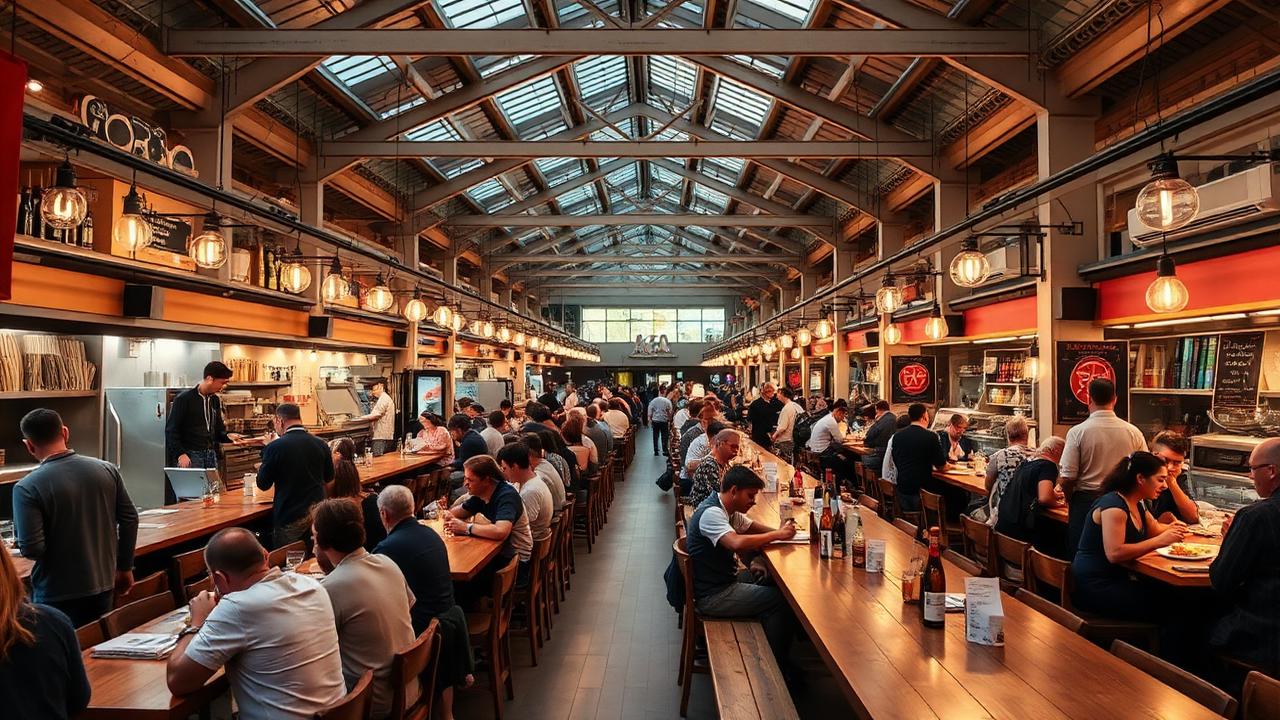
Plov houses are not going anywhere. But the fastest-changing part of Tashkent eating in 2026 is the food hall — twenty kitchens, one table, and a menu that runs from lagman to Korean fried chicken.
For most of the last century, eating out in Tashkent meant three formats: the chaikhana, the plov centre and the restaurant. The food hall — a converted hall or mall floor with a ring of independent kitchens and shared seating — is new here, and it has spread quickly because it fits how the city already eats: in groups, loudly, with everyone wanting something different.
How ordering works
You find a table first, then split up and order at whichever counters you want. Most halls run on one of two systems: a card you load at the entrance and tap at each stall, or direct payment at each counter with a buzzer. Both work with local bank cards; the card-at-entrance system sometimes struggles with foreign cards, so carry cash as a backup. Bussing your own tray is expected in the newer venues and ignored in the older ones.
What you will actually spend
- A full main dish at a hall stall: roughly 40,000–80,000 soum.
- Speciality coffee: 25,000–40,000 soum, and it is genuinely good in Tashkent now.
- A shared table meal for four with drinks: comfortably under 400,000 soum.
- Service charge is usually not added at counters — a change from restaurant billing.
What to order that you cannot get in a restaurant
Food halls are where the hybrid cooking happens. Look for Korean-Uzbek stalls run by the Koryo-saram community, whose kimchi and marinated salads have been part of Tashkent bazaars for generations and are finally getting proper kitchens. Look for tandoor stalls doing samsa in unfamiliar fillings, for the Uyghur lagman counters that hand-pull to order, and for the small-batch bakeries selling non alongside sourdough without any sense of contradiction.
The one rule
Follow the queue. In a hall with twenty counters, the three with lines are carrying the place and the rest are riding on the rent. This is more reliable than any review app in Uzbekistan, where restaurant ratings are thin and heavily gamed.
Hours, alcohol and families
Most halls open around midday and run to 22:00 or 23:00, later on weekends. Alcohol licensing varies by venue — many have one bar counter rather than alcohol at every stall. They are overwhelmingly family spaces: expect children running between tables until late, which is normal and not a sign that you have wandered somewhere inappropriate. During Ramadan, daytime trade drops and iftar seating fills up an hour before sunset.
Food halls versus the bazaar
A food hall is not a replacement for Chorsu. The bazaar remains cheaper, rougher and more interesting, and its food stalls cook a narrower, older menu extremely well. The honest split: go to the bazaar for a morning and a plate of something you did not choose, and go to a food hall in the evening when your group cannot agree and somebody wants a flat white after dinner.
Vegetarians, finally
This is the practical reason to care. Uzbek restaurant menus are hard work without meat. Food halls solve it — a group can sit together while one person eats a full vegetarian meal from a dedicated counter, which was close to impossible in a plov house. If you are travelling with a vegetarian or vegan, put one hall in the itinerary for every two or three traditional meals and the trip gets much easier.