Rishtan Ceramics: Inside the Fergana Valley Workshops Pinterest Discovered (2026 Buying Guide)
· 10 min read · Shopping
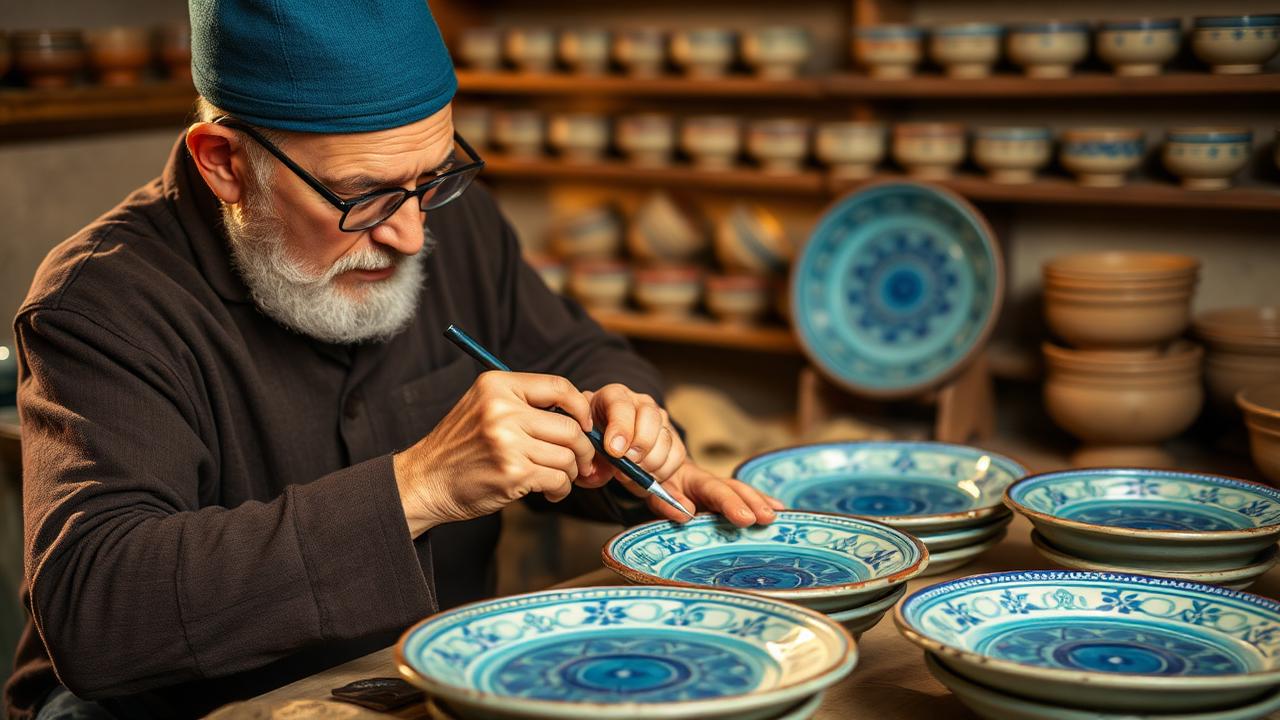
Every cobalt-and-turquoise plate flooding Pinterest under #UzbekCeramics comes from one small town in the Fergana Valley. Here's the 2026 guide to actually going there, meeting the masters, and bringing one home unbroken.
Open Pinterest, search 'Uzbek ceramics,' and ninety percent of what you see was made in Rishtan — a small town of 32,000 people in the Fergana Valley that has been producing glazed pottery for more than 800 years. The cobalt blue, the turquoise green, the pomegranate motifs, the fish, the suns: it all comes from here. There are over 200 working potters in Rishtan today. This is the 2026 guide to visiting them, understanding what makes Rishtan ceramics unique, and bringing pieces home without losing them to airport security.
Why Rishtan?
The local red clay (sokhumtosh) is unusually plastic and fires to a creamy off-white. More importantly, the mountains around Rishtan contain a wild plant called ishkor (a salt-tolerant Salsola species) whose ash is the key ingredient in the traditional Rishtan glaze. Ishkor glaze fires at a lower temperature, creates a soft, slightly cracked surface, and reacts with cobalt and copper oxides to produce the signature deep blue and turquoise that no other Central Asian center has matched.
How to recognize real Rishtan ceramics
- Color: deep cobalt blue and turquoise-green dominate; secondary motifs in ochre and brown.
- Glaze: slightly uneven, with hair-fine crackle (kanavki) — this is desired, not a defect.
- Motifs: pomegranate (anor), fish (baliq), almond (bodom), sun (quyosh), peacock feather.
- Back of plate: should have three small unglazed spots from the kiln stilts.
- Signature: master pieces are signed on the back in Cyrillic or Arabic script.
- Sound: gently tap the rim — real ishkor-glazed Rishtan rings softly, fakes thud.
The masters to visit in 2026
Rustam Usmanov workshop
The most internationally known Rishtan master — pieces in the V&A, the Hermitage, and the Metropolitan Museum. His workshop is a small museum, open most days 9:00–17:00. Plates from 200,000 UZS, museum-quality pieces from $300.
Alisher Nazirov workshop
Younger generation, contemporary patterns, very active on Instagram. His workshop has demo kilns and English-speaking apprentices. Easier to arrange a one-hour painting workshop here (around 200,000 UZS per person, plus the cost of your piece).
Damir Usmanov (Rustam's son)
Continuing the family tradition with modernized designs. Smaller workshop, but worth the visit if Rustam's is full of tour groups.
Rishtan Ceramics Center
Cooperative selling work from 40+ smaller potters. Best place to see range, compare quality, and pick a $20 souvenir without committing to a $400 plate.
How to get to Rishtan in 2026
- From Tashkent: fly to Fergana (50 min, 350,000 UZS), then taxi to Rishtan (40 min, 80,000 UZS).
- From Tashkent by train: Afrosiyob through Kamchik tunnel to Margilan (5h, 300,000 UZS), then shared taxi to Rishtan (45 min, 25,000 UZS).
- From Kokand: shared taxi 35 min, 20,000 UZS per seat.
- Day trip from Margilan including Rishtan + Yodgorlik silk factory: $70 with car and driver.
2026 prices
- Small souvenir plate (15 cm) — 80,000–150,000 UZS ($7–13)
- Mid-size plate (25 cm) — 250,000–600,000 UZS ($21–50)
- Large lyagan serving plate (40 cm) — 800,000–2,000,000 UZS ($67–170)
- Master-signed museum piece — $200–800
- Painting workshop (1 hour + take your piece) — 200,000–350,000 UZS ($17–30)
- Full-day workshop with throwing + glazing — $80–120 per person
How to get them home unbroken
- All serious workshops will pack plates in custom wooden crates with straw and foam — ask for 'expeditsiya upakovka.'
- Carry-on for one or two flat plates: wrap each in clothing, pad the edges, slide into hard-shell laptop sleeve.
- DHL Tashkent ships internationally — a 30 cm plate to the US runs $80–120 with full insurance.
- EMS Uzbekistan Post is cheaper ($25–40) but slower and damage rate is higher; insist on 'fragile' stickers.
- Customs: Uzbekistan allows export of contemporary ceramics with the shop receipt; no antique permit needed for new work.
Honest verdict
Rishtan deserves a full day, not a 90-minute bus stop. Spend the morning in two workshops, eat plov in town for 30,000 UZS, paint your own plate in the afternoon, and ship it home the next morning from Fergana DHL. You will own a piece of an 800-year-old craft made by the actual hands of the person whose Instagram you've been following — and you will have paid them directly. That is worth a detour from any Tashkent–Samarkand itinerary.