Why Uzbek Bazaars Sell Korean Salads: The Koryo-Saram Story Behind Morkovcha (2026)
· 10 min read · Food & Drink
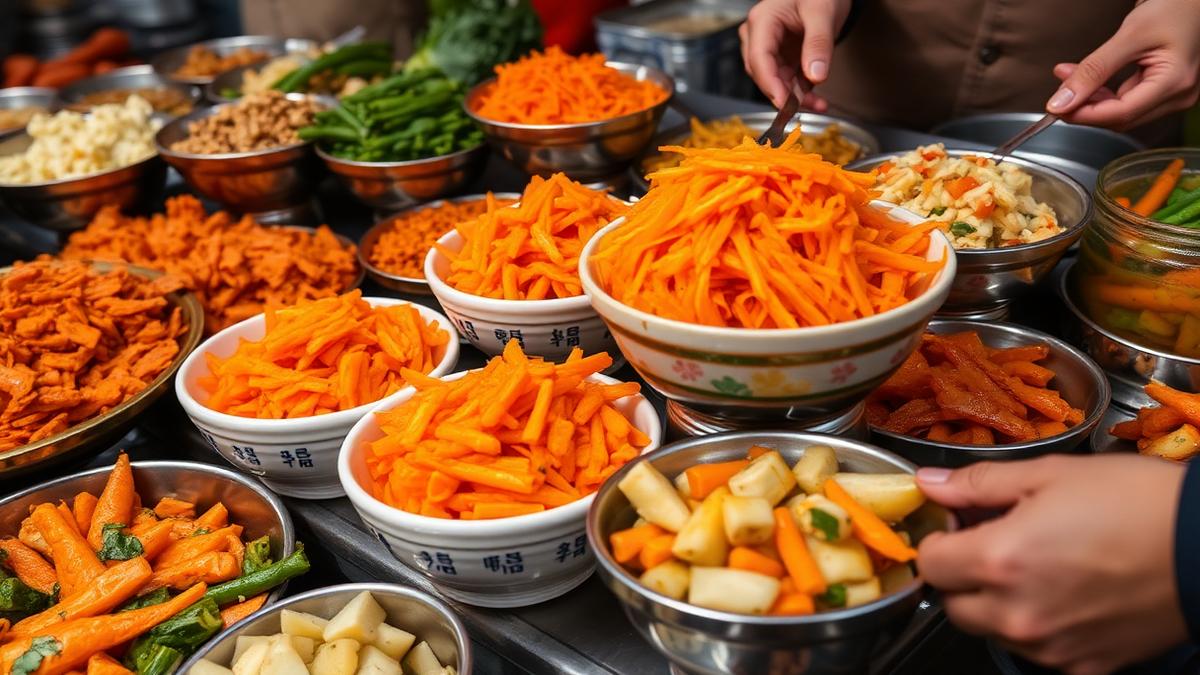
Walk into any Uzbek bazaar and you will find a whole row of Korean salads sold by Uzbek-Korean vendors. The reason goes back to a 1937 deportation — and produced one of the world's most unlikely cuisines.
First-time visitors to Chorsu Bazaar almost always ask the same question: why is there an entire aisle of Korean food in the middle of Uzbekistan? Bright orange shredded carrot salad, kimchi, glass-noodle funchoza, chilli-marinated aubergine, sold by vendors who speak Uzbek and Russian and whose grandparents were born near Vladivostok. The answer is one of the least-known population movements of the 20th century — and it produced a genuinely unique cuisine you cannot eat anywhere else in the world in this form.
Who are the Koryo-saram?
Koryo-saram (고려사람, literally 'Koryo people') are ethnic Koreans of the former Soviet Union. Their ancestors migrated from northern Korea into the Russian Far East from the 1860s onwards, fleeing famine and Japanese colonial rule. By the 1930s around 170,000 lived around Vladivostok and Primorye.
The 1937 deportation
In autumn 1937, Stalin's government deported virtually the entire Korean population of the Soviet Far East, accused collectively of potential espionage for Japan. They were loaded onto cattle trains and moved thousands of kilometres west to Kazakhstan and Uzbekistan over several weeks. Thousands died in transit and during the first winter. Survivors were dropped on empty steppe and marshland, mostly in the Tashkent region and around the Syr Darya, and told to farm it.
They did. Korean collective farms in Uzbekistan became some of the most productive in the entire Soviet Union — the Polytotdel farm outside Tashkent was famous nationally for rice and onions. Today around 170,000–180,000 Koryo-saram live in Uzbekistan, one of the largest Korean communities outside Korea and China, concentrated in Tashkent, the Tashkent region and Syrdarya.
How the food changed
Cut off from Korea for generations, the deportees rebuilt their cuisine with Central Asian ingredients. Napa cabbage was scarce, so they pickled carrots. Korean chilli paste was unavailable, so they used ground red pepper, garlic, vinegar and hot oil. Soviet food industry pantry items entered the recipes. The result is a cuisine that is recognisably Korean in technique and completely Central Asian in ingredients — and that modern South Korean visitors often find fascinating and slightly unfamiliar.
What to order at the bazaar
Morkovcha (마르코브차 / морковча)
The famous one: julienned raw carrot marinated with garlic, vinegar, coriander seed, black pepper and hot oil. Sharp, sweet, garlicky, addictive. Invented by Koryo-saram in Central Asia — it does not exist in Korea. Around 15,000–25,000 soʻm per half kilo.
Kimchi (chimchi)
Local version is usually milder, more vinegar-forward and less fermented than Korean kimchi. Sold by weight from plastic tubs.
Funchoza
Cold glass-noodle salad with peppers, carrot, garlic and sesame oil, sometimes with beef. The default Uzbek party salad in half the country now.
Pyanse (пянсе)
Large steamed bun stuffed with cabbage and minced meat — the Koryo-saram cousin of Korean wangmandu. Sold hot from street kiosks for 12,000–18,000 soʻm. Perfect winter street food.
Kuksi / kuksu
Cold noodle soup with cucumber, egg, beef and a sour chilled broth. The regional answer to naengmyeon, and the single best thing to eat in Tashkent in July.
Where to eat it
- Chorsu Bazaar, Tashkent — the classic Korean salad row, best before noon.
- Alay (Oloy) Bazaar, Tashkent — smaller, cleaner, easier for first-timers.
- Any large regional bazaar in Samarkand, Bukhara or Fergana will have at least one Korean salad vendor.
- Dedicated Korean-Uzbek cafés around Tashkent serve kuksi, pyanse and Korean-style beef in a sit-down setting.
Practical tips for buying
- Everything is sold by weight — say 'yarim kilo' (half a kilo) or just point and say 'ozgina' (a little).
- Tasting before buying is normal and expected; vendors will hand you a sample on a fork.
- Salads are made fresh daily and are not preserved for travel — eat within a day or two, and do not pack morkovcha in a suitcase.
- Most stalls are cash-only; small soʻm notes help.
- Vegetarians: many salads are vegetable-only, but check for beef in funchoza and fish sauce in kimchi.
Why this matters beyond lunch
The Korean salad aisle is the most visible surviving trace of a deportation almost no travel guide mentions. Uzbekistan absorbed deported Koreans, Crimean Tatars, Volga Germans, Meskhetian Turks and Poles across the 1930s and 40s, and the country's food, faces and surnames still carry that history. Eating morkovcha in a Tashkent bazaar is a small, direct encounter with it.