Konigil Silk Paper Mill (2026): How Samarkand Brought Back a 1,200-Year-Old Craft
· 9 min read · Culture
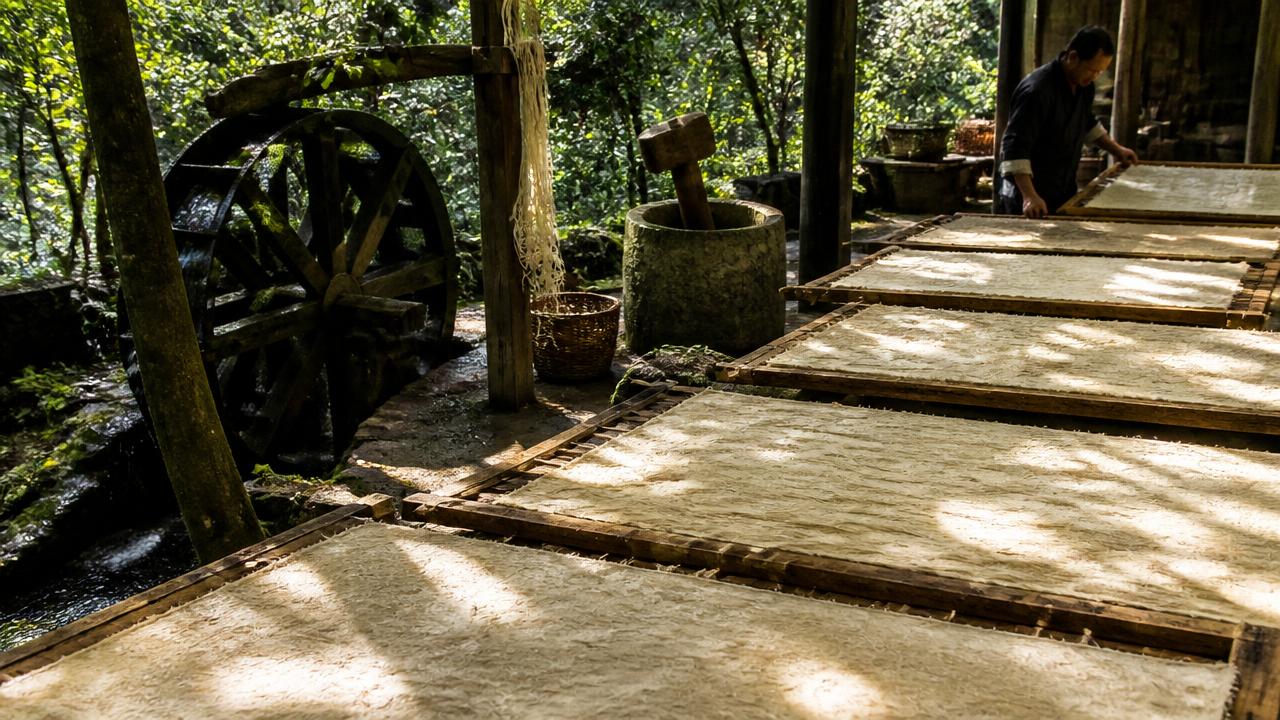
Long before Samarkand was famous for tiled domes, it was famous for paper. The recipe was lost for centuries. Just outside the city, a family of craftsmen rebuilt it from scratch — water wheel included.
Samarkand's most consequential export was not silk. It was paper. In the 8th century, papermaking knowledge reached the city from China, and Samarkand became the first great papermaking centre of the Islamic world — the point at which a Chinese technology entered the libraries, chancelleries and scriptoria of the Middle East and, eventually, Europe. Samarkand paper was a luxury brand for centuries. Then industrial pulp arrived, the craft died out, and for a very long time nobody in Uzbekistan made it at all.
The revival at Konigil
In the village of Konigil, on the Siyob river a short drive from central Samarkand, a workshop rebuilt the process from historical descriptions and trial and error, and now makes mulberry-bark paper by hand using a water-powered mill. It is a working craft site rather than a museum installation: the wheel turns, the hammers fall, the pulp is real, and the paper goes out the door as a product.
Why it is called silk paper
The name has nothing to do with silkworms and everything to do with the raw material and the finish. The bark of the mulberry tree — the same tree that feeds Uzbekistan's silkworms — produces long, strong fibres. Once pounded, sheeted, dried and burnished smooth with a stone or a piece of horn, the surface takes on a soft sheen and a cloth-like flexibility. Hence silk paper.
How the paper is made
- Mulberry branches are cut and the inner bark is stripped away from the outer layer.
- The bark is boiled for hours until it softens into fibre.
- A water wheel drives wooden hammers that pound the boiled fibre into pulp — the loudest and most photogenic part of the visit.
- The pulp is suspended in a vat of water and lifted out on a fine screen, one sheet at a time.
- Sheets are pressed, dried, then burnished by hand with a smooth stone until they shine.
The whole sequence uses water, wood, bark and muscle. There is no bleach and no synthetic sizing, which is exactly why conservators and calligraphers are interested in the output: handmade mulberry paper is unusually durable, and the historical claim that Samarkand paper lasted centuries is not marketing.
What the visit is actually like
Expect a shaded riverside compound rather than a slick visitor centre — trees, running water, a wheel, drying frames, workbenches and a shop. Demonstrations run through the working day and take well under an hour. Craftsmen show each stage, usually let visitors try lifting a sheet, and are happy to be photographed at work. It is one of the few stops in Samarkand where you learn a process rather than look at a facade, which makes it a good counterweight to a day of monuments.
Getting there and timing
- Location: Konigil village, on the outskirts of Samarkand — roughly 15–20 minutes by car from the Registan area depending on traffic.
- How: a Yandex Go ride is the simplest option. Arrange the return or ask the driver to wait, because it is not a place where cars queue up.
- How long: allow an hour, or ninety minutes if you want to browse and talk to the craftsmen.
- When: mornings are cooler and quieter; the site is outdoors, so summer afternoons are hot.
- Combine it with the Siyob bazaar or Ulugh Beg's observatory, both on the same side of the city.
What to buy, and what it is worth
- Loose sheets of plain silk paper — light, flat, unbreakable in luggage, and the single best cheap souvenir in Samarkand.
- Notebooks and sketchbooks bound in the same paper.
- Miniature paintings and calligraphy done on the paper itself.
- Lamp shades, masks, bags and small decorative objects made from pressed pulp.
- Prices are modest by souvenir standards, and unlike ceramics or carpets nothing here risks breaking or triggering an export question at the airport.
Why this one is worth your time
Uzbekistan has plenty of craft stops that are really shops with a demonstration attached. This is the reverse: a genuine reconstruction of a technology that mattered historically, run by the people who brought it back, in a setting that costs almost nothing to visit. If you have half a day in Samarkand beyond the monuments, spend part of it here.
Opening hours and demonstration times can vary seasonally — check locally on the day. For other craft towns, see /blog/margilan-yodgorlik-silk-factory-atlas-ikat-guide-2026 and /blog/rishtan-ceramics-workshop-fergana-pottery-guide-2026