Khiva at Night: A Lantern Walk Through the Walled City (2026)
· 10 min read · Cities
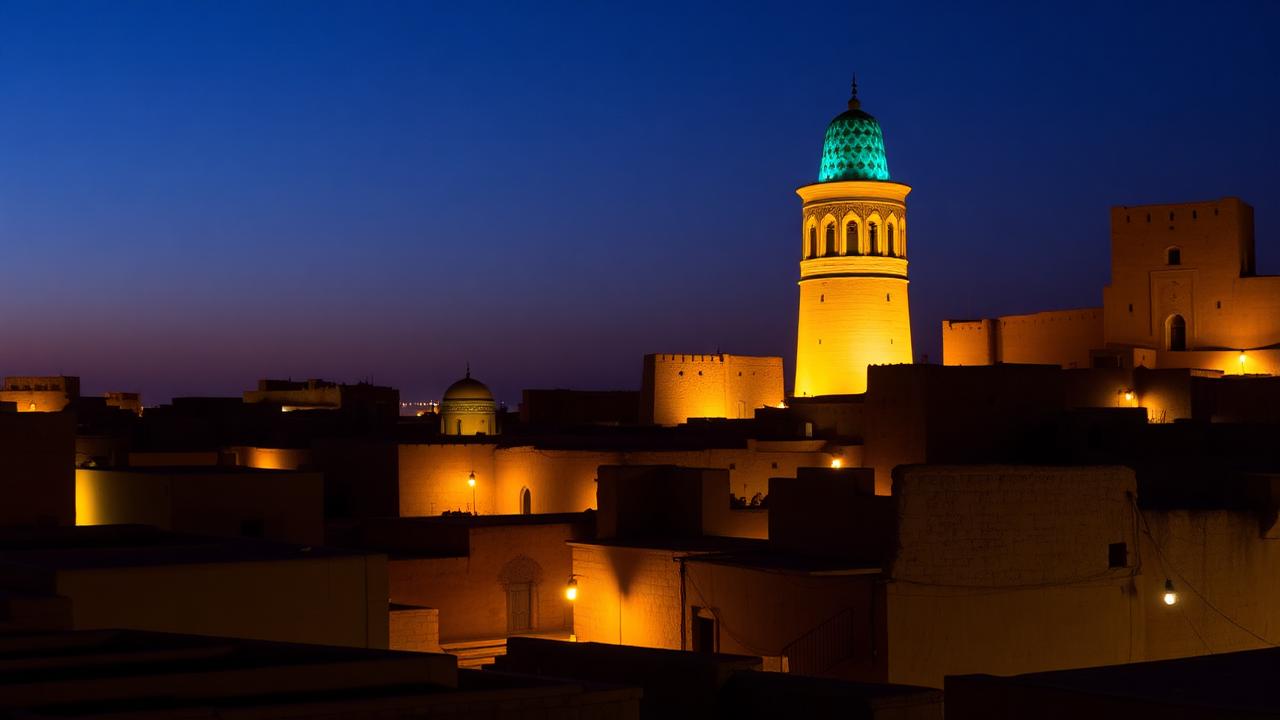
Most tourists leave Khiva by 5 PM. That is when the real city begins. Here's how to experience Itchan Kala after dark — the lantern-lit alleys, empty mosques, and moonlit minarets that make Khiva feel like a dream.
Khiva is beautiful during the day — the turquoise tiles of the Kalta Minor, the carved wooden doors of the Juma Mosque, the sand-colored walls that glow gold in the afternoon sun. But Khiva at night is something else entirely. When the tour buses leave, when the souvenir sellers pack up, when the daytime heat finally breaks, Itchan Kala becomes one of the most atmospheric places on Earth. The alleys are empty. The mosques are silent. The only light comes from old-fashioned lanterns mounted on mud walls, casting long shadows across 800-year-old cobblestones. This is the Khiva that Silk Road travelers saw centuries ago. And almost no one stays to see it.
Why you must stay overnight inside the walls
Most tourists visit Khiva as a day trip from Urgench or even Samarkand, arriving at 10 AM and leaving by 4 PM. They see the museums, buy a ceramic plate, and miss the entire point of the city. Khiva was built as a fortified oasis — a place of shelter, prayer, and trade on the edge of the Kyzylkum desert. Its soul reveals itself only after sunset, when the last day-trippers are gone and the city breathes again. If you do one thing differently in Uzbekistan, let it be this: stay inside Itchan Kala overnight.
The self-guided lantern walk (1.5–2 hours)
This route assumes you are staying inside the walls (see accommodation recommendations below). Start just after sunset, around 8:30 PM in summer or 6:30 PM in winter. Bring a light jacket — desert nights can drop 15°C from daytime temperatures. No flashlight needed — the lanterns are enough.
Stop 1: Kalta Minor at blue hour
Begin at the Kalta Minor, the fat unfinished minaret covered in bands of turquoise, blue, and white tiles. During the day it is surrounded by selfie sticks. At night, with the sky still deep blue and the minaret softly illuminated from below, it is mesmerizing. The tilework glows like a lantern itself. This is your first photograph — wide angle, low to the ground, the minaret rising against a star-scattered sky.
Stop 2: Juma Mosque in silence
Walk south to the Juma Mosque, famous for its 218 carved wooden columns — no two alike, some dating to the 10th century. During the day, guides shout explanations over the echo. At night, the mosque is closed to entry, but you can stand in the courtyard in absolute silence. The columns cast shadows in the moonlight like a forest of ancient trees. If you are lucky and the moon is bright, you do not need artificial light at all.
Stop 3: The old city walls — east gate
Walk to the eastern city walls, the oldest surviving section. The mud-brick ramparts are lit by warm sodium lamps that make them look like solid gold. Sit on the old firing ledge and look out over the dark desert — nothing but flat sand and distant stars for 100 km. This is the edge of the known world, or at least it was for Silk Road traders. Feel it.
Stop 4: The madrasa courtyards
Many of Khiva's madrasas have been converted into hotels, workshops, or museums. At night, their central courtyards are empty and open. The Muhammad Amin Khan Madrasa (now a hotel) has a stunning courtyard with a reflecting pool that mirrors the arches — a perfect long-exposure shot. The Islam Khoja Madrasa's minaret, the tallest in Khiva at 57 meters, is illuminated and visible from almost anywhere in the old city. Use it as your navigation beacon.
Stop 5: The carpet workshop alley
Near the west gate, a narrow alley still contains a working carpet workshop. The owner often works late into the night, and if you pass quietly, you may see the loom lit by a single bulb, the weaver's hands moving in a rhythm older than the city. Do not disturb — just observe. This is the Khiva that existed before tourism.
Night photography in Khiva: tips
- Tripod essential — alleys are uneven and long exposures are unavoidable. A travel tripod (under 1.5 kg) is fine.
- Best settings: ISO 1600–3200, f/2.8 or widest available, 1/15 to 4 seconds depending on the scene.
- The lanterns are sodium-vapor (warm orange) — set white balance to tungsten or 2700K for accurate colors.
- Blue hour (20–30 minutes after sunset) is the best light — the sky is still deep blue, artificial lights are on, and you get both in one frame.
- The Kalta Minor is floodlit — bracket your exposures or underexpose by 1 stop to preserve the glowing tiles.
- Bring a remote shutter or use the 2-second timer to avoid camera shake on cobblestones.
Where to stay inside Itchan Kala
- Hotel Orient Star (inside Muhammad Amin Khan Madrasa): sleep inside a 19th-century madrasa. Rooms are simple, the courtyard is stunning, and you have the run of the place after 7 PM. $50–80/night.
- Arkanchi Hotel: boutique guesthouse inside the walls, rooftop terrace with Kalta Minor views. $60–100/night.
- Shaherezada Boutique Hotel: small, family-run, courtyard garden, excellent home-cooked breakfast. $40–70/night.
- Meros B&B: budget option inside the walls, basic but clean, friendly family, $25–40/night.
Safety at night
Khiva is extremely safe at night. The old city has a 24-hour security presence (it is a UNESCO site and effectively a living museum), and the streets are patrolled. The only real risks are tripping on uneven cobblestones in the dark and the cold — bring a jacket even in summer. Solo female travelers report feeling very safe walking alone inside the walls at night, more so than in Tashkent.
When to visit for the best night experience
- April–May: warm evenings, star-filled skies, wildflowers visible in the morning. Perfect.
- September–October: crisp air, clear skies, ideal for photography. The desert cool is refreshing.
- November–March: very cold at night (below freezing), but the city is almost entirely empty — if you can handle the cold, this is the most atmospheric time.
- June–August: hot even at night (25–30°C), but the sunsets are spectacular and the late light is golden.
Final word
Khiva at night is not an 'activity' to tick off a list. It is an experience that changes how you think about ancient cities. The silence, the lanterns, the moonlight on mud walls that have stood for a thousand years — this is why people traveled the Silk Road. Not for the trade, but for the moments of stillness in places that knew eternity. Stay overnight. Walk slowly. Let the city speak.