Inside Tashkent's New Center of Islamic Civilization: Tickets, Hours & What to See (2026)
· 9 min read · Art & Architecture
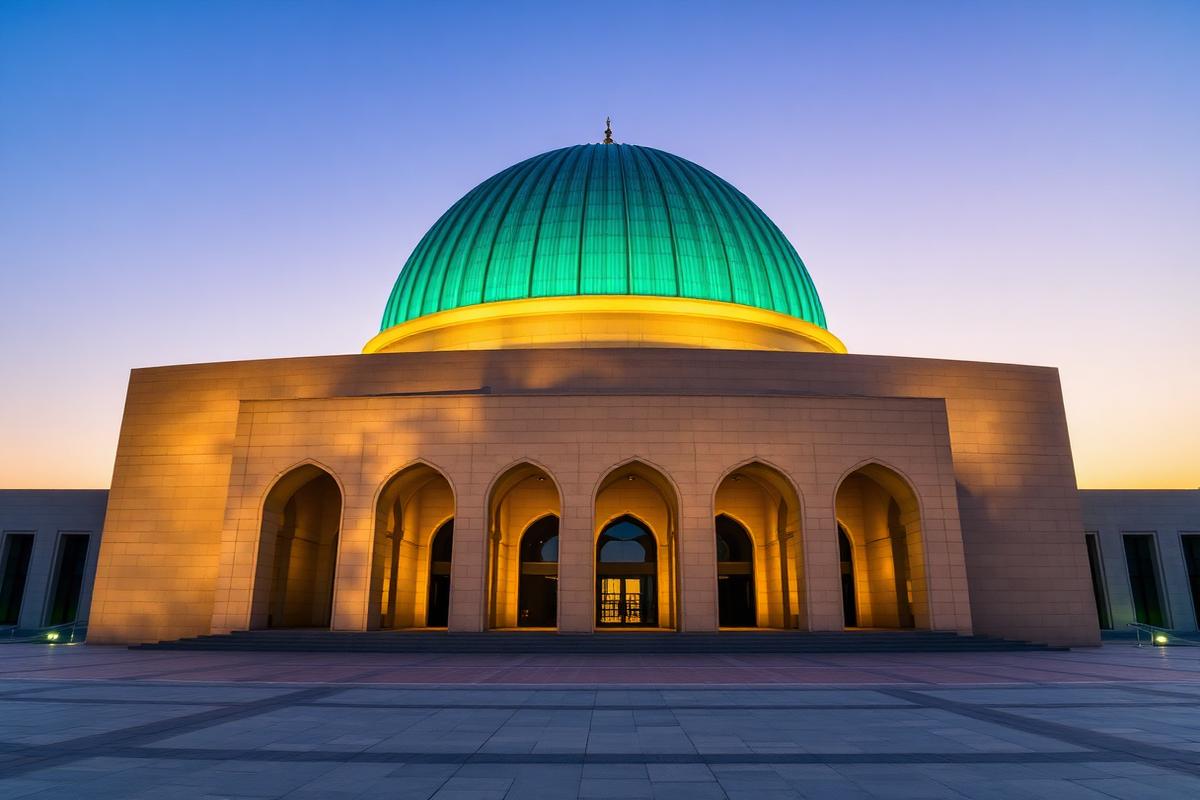
Four times taller than the Hollywood sign and crowned by a 65-metre turquoise dome, the Center of Islamic Civilization is the most ambitious cultural project modern Uzbekistan has ever built — and at under $15 for a family, one of the best-value museums on earth.
Four times taller than the Hollywood sign and crowned by a 65-metre turquoise dome, the Center of Islamic Civilization is the most ambitious cultural project modern Uzbekistan has ever built. It opened to the public on 17 March 2026, in the final days of Ramadan, after eight years of construction and a budget of around $150 million. Within days it was named to the Prix Versailles list of the world's most beautiful museums, and it had already been flagged by CNN, Smithsonian Magazine, BBC Travel and Conde Nast Traveler as one of the year's most anticipated openings. If you are visiting Tashkent in 2026, it has become as essential as Chorsu Bazaar or the Hazrati Imam complex next door.
What it actually is
The Center is not simply a museum. It is a three-storey cultural, educational and research megaproject built to reinterpret Central Asia's role in the history of Islamic science and thought. It sits in Tashkent's historic Hast-Imam (Hazrati Imam) district — the spiritual heart of the capital — at 47 Karasaray Street in the Almazar district, placed deliberately beside the centuries-old Hazrati Imam ensemble so that old and new speak to each other. The 65-metre dome and four portals are designed to symbolise the unity of Uzbekistan's regions, echoing the domes of the neighbouring complex.
The idea was first announced by President Shavkat Mirziyoyev from the United Nations podium in 2017. Eight years later it stands as the flagship statement of what the country calls 'New Uzbekistan': a bridge between the Golden Age of Central Asian scholarship — the era of algebra, astronomy, medicine and philosophy — and the country's modern ambitions. In December 2025 the Center signed a memorandum of understanding with the United Nations Alliance of Civilizations, underlining that its ambitions are international, not just national.
The Uthman Quran and the Quran Hall
At the symbolic centre of the building, directly beneath the dome, is the Quran Hall. Its centrepiece is the Mushaf of Uthman — one of the oldest surviving copies of the Quran in the world, inscribed on the UNESCO Memory of the World Register. This 7th-century Kufic manuscript, associated with Samarkand, is displayed as the literal and spiritual core around which the entire building is organised. For many visitors, standing before it is the single reason to come.
The four halls
The permanent exhibition holds more than 2,000 objects — everyday tools, manuscripts, books, archaeological finds and works of decorative and applied art, many repatriated to Uzbekistan from collections around the world. Modern museum technology, including digital interpretation and elements of AI, is used throughout — not as spectacle, but to widen access and clarify context. The layout runs through four thematic halls:
- Pre-Islamic Heritage — the region before Islam, from Zoroastrian and Buddhist Central Asia onward.
- First Renaissance — the age of al-Khwarizmi (the father of algebra), al-Biruni, Avicenna (Ibn Sina) and Imam al-Bukhari, when Samarkand and Bukhara were among the most intellectually vibrant cities on earth.
- Second Renaissance — the Timurid flowering under Ulugh Beg, the astronomer-prince of Samarkand, and his successors.
- New Uzbekistan — the modern chapter, linking that inheritance to the country today.
Beyond the exhibitions the building houses a research library of around 200,000 books, restoration laboratories, and a 460-seat conference hall built for international forums.
Tickets and opening hours (2026)
The Center made Uzbek museum history by opening in the evenings — a first for the country, designed for families visiting after work. Confirmed 2026 details:
- Opening hours: daily 09:00–22:00, with no days off (some listings state 10:00; confirm on arrival). The illuminated dome after dark is spectacular — an evening visit is worth timing for.
- Group excursion ticket (2-hour guided tour): around 60,000 soum for adults and 25,000 soum for children aged 7–17. Reporting at launch noted that a family of two adults and two children could visit for under $15 total.
- Buying tickets: available on-site (including ticket machines) and via tour operators offering skip-the-line guided visits in English, French, Turkish, German, Spanish, Italian, Russian, Arabic, Chinese, Japanese and Uzbek. Book ahead in peak season.
- Prices change — treat the som figures above as a 2026 reference and confirm current rates when you buy.
Planning your visit
- Crowds & time: up to 5,000 visitors a day at peak times. Allow at least 3–4 hours; the guided tour is about 2 hours but the exhibitions reward longer.
- Dress code: modest dress, shoulders and knees covered; women may want a scarf.
- Address: 47 Karasaray Street, Almazar district, Hast-Imam area, Tashkent.
- Combine with: the Hazrati Imam complex next door — the Tillya-Sheikh Mosque and Barak-Khan Madrasah — plus Chorsu Bazaar and a Tashkent plov centre for a full old-city day.
How to get there
From central Tashkent, a Yandex Go ride to Hast-Imam is short and inexpensive; depending on your line, the metro gets you within a walkable distance. Pair the Center with the old-town sights above and you have one of the best single days in the capital.
One honest note
A recurring criticism in early visitor reviews is that the displays foreground male scholars and rulers and under-represent women's contributions to the region's history. You may weigh this differently, but it's a live part of the conversation around the Center and worth going in aware of.
The bottom line
The Center of Islamic Civilization is the clearest physical expression yet of how Uzbekistan wants the world to see it in 2026: not as a stopover, but as the heartland of a civilisation that shaped mathematics, medicine and astronomy. Whether you come for the Uthman Quran, the architecture, or the story it tells, it is no longer optional on a Tashkent itinerary — and at under $15 for a family, it's one of the best-value world-class museums on the planet.
Ticket prices and hours are 2026 references and can change; confirm current details on arrival or with a licensed operator.