Bukhara's Stork Scissors: The Hand-Forged Souvenir With a 900-Year-Old Story
· 8 min read · Culture
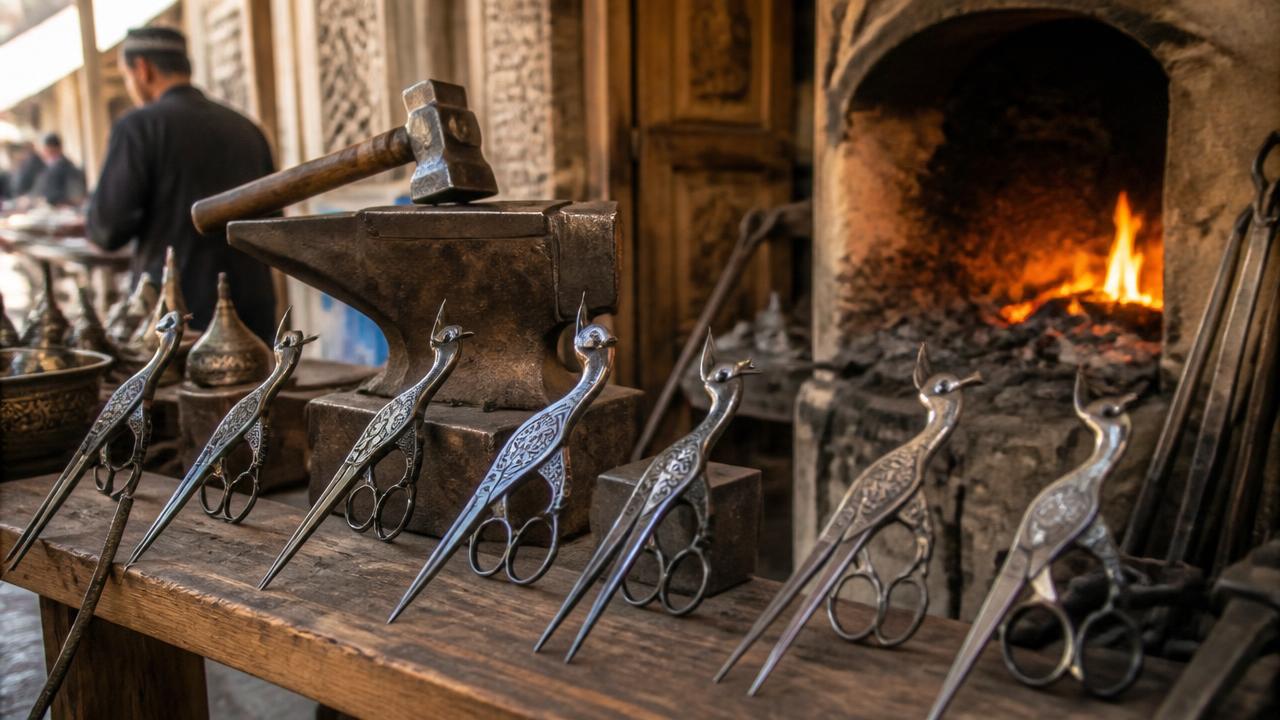
They look like a gimmick and they are not. Bukhara's stork-shaped scissors are hand-forged by a small number of families, carry a genuine local legend, and are the one souvenir in the old town that still gets made in front of you.
Walk the lanes between Bukhara's trading domes and you will pass a workshop with the door open, a forge glowing at the back and a row of long-beaked steel birds standing on a bench. Pick one up and it opens: the beak is the blade, the body is the handle. These are Bukhara's famous stork scissors, and unlike most things sold in the old town, they are still made by hand, in the city, by people you can watch working.
Why storks
The white stork was once part of Bukhara's skyline. Nests sat on minarets, madrasa parapets and the towers of the old town, and the birds were treated as bringers of luck, fertility and good fortune — killing one was regarded as shameful. As Bukhara's wetlands and irrigation landscape changed through the 20th century, the nesting storks largely disappeared from the city. The scissors are the memory of them: local craftsmen kept forging the bird's silhouette after the bird itself stopped coming back, which is why nearly every workshop tells you the same thing — in Bukhara the storks live on the shelves now.
The blacksmith's legend
The craft is tied to families who trace their trade back generations, and the workshops usually tell a version of the same story: a smith working under a nesting stork, an apprenticeship passed father to son, and a shape that started as a tribute and became a signature. Treat the specific dates as a family tradition rather than a documented chronicle — but the continuity of the craft in Bukhara is real, and the tools on the bench are not decorative.
How they are made
- The smith heats steel in a coal forge until it is workable — often reusing dense, high-quality scrap steel rather than new stock.
- Each half is hammered out on the anvil into a blade that doubles as the stork's beak and a shank that becomes its neck and body.
- The head, eye and crest are punched and filed by hand, which is why no two are quite identical.
- Surfaces are engraved or chased with fine ornament, then polished.
- The halves are riveted, and — crucially — the blades are ground so they actually cut.
A working pair is a real tool. Embroiderers use them, and the fine-tipped versions are genuinely good for thread work. The oversized display pieces are ornaments and honest about it.
How to spot the real thing
- Watch the shop. If there is a forge, an anvil, scale on the floor and someone actually working, you are in a workshop, not a reseller.
- Check symmetry. Hand-forged pairs are slightly asymmetric in the ornament; identical, perfectly repeated pieces stacked in a box are usually cast or imported copies.
- Look at the blades. Real ones meet cleanly and cut paper. Souvenir copies often have blunt edges that never quite close.
- Feel the weight. Forged steel is dense; light, tinny pieces are a bad sign.
- Ask about the steel. Craftsmen who forge their own will talk your ear off about it; resellers change the subject.
Prices and what to expect in 2026
- Small working scissors: the everyday, giftable size, usually the best value in the shop.
- Mid-size decorated pairs with engraving and a stand: the most common tourist purchase.
- Large display pieces: statement objects, priced accordingly, and awkward to pack.
- Bargaining is normal but light — this is skilled labour, and a hard haggle in a working forge lands badly. Cards are widely accepted in the old town, but small workshops may prefer cash.
Flying home with them
They are blades. Put them in checked luggage, always — a pair of stork scissors confiscated at security is a sad end to the story. Sharp new metalwork counts as an ordinary good, not an antique, so it is straightforward at customs; anything genuinely old is a different conversation. If your purchase clears the minimum, hand-forged metalwork is a good, and therefore eligible for the Tax Free VAT refund.
Prices, workshops and opening hours change; ask locally in the trading domes. For the wider shopping picture see /blog/uzbekistan-customs-export-rules-souvenirs-guide-2026 and /blog/chust-pichok-knife-fergana-valley-craftsmen-guide-2026