Ak-Saray Palace & Shahrisabz: Standing Where Timur Was Born (2026 Guide)
· 10 min read · History
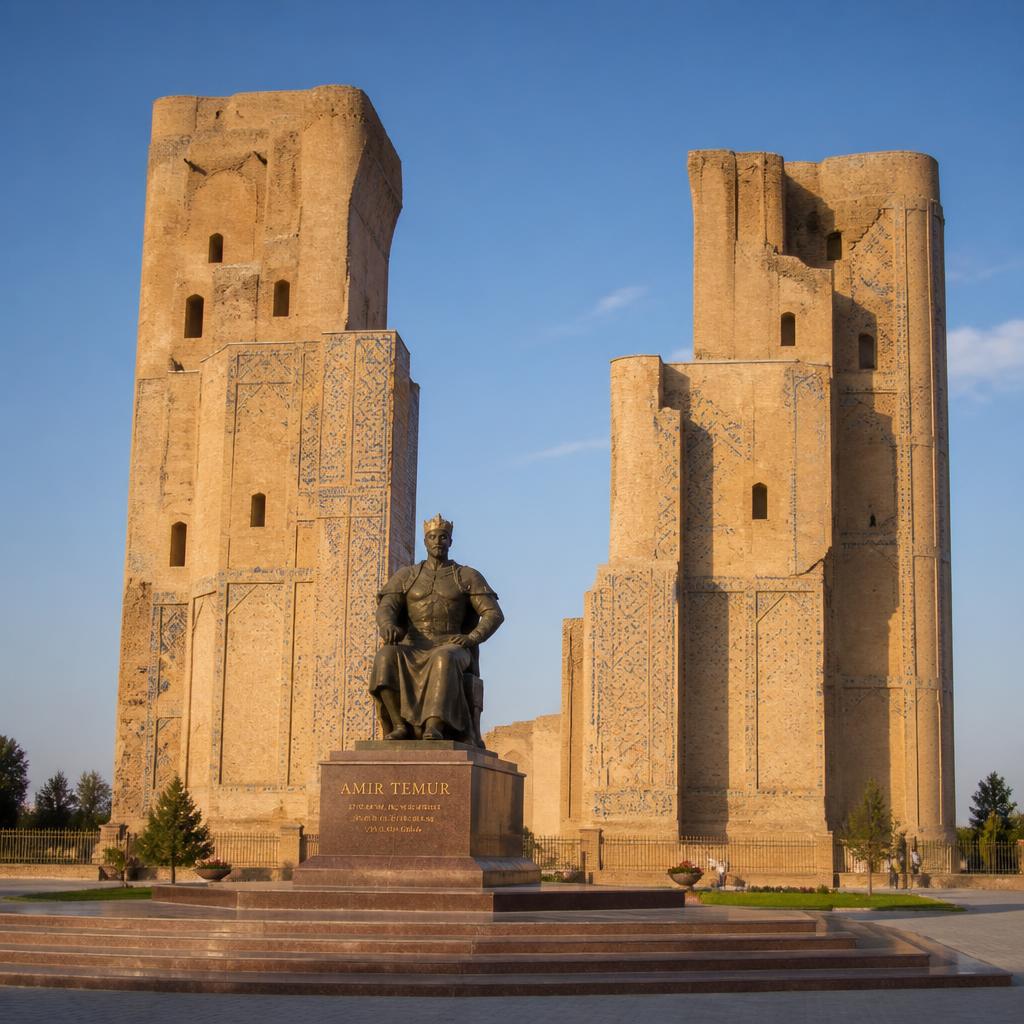
Ninety kilometres south of Samarkand, over a mountain pass, lies the small green town where Tamerlane was born. He tried to build a palace so tall it would humble the sky. Only two 38-metre pylons still stand — and standing between them changes how you see him.
Everyone visits Samarkand for Timur. Almost nobody makes it to the town where Timur was actually born — Shahrisabz, 'Green City', 90 km south over the Takhtakaracha pass. UNESCO World Heritage since 2000. The ruins of Ak-Saray, his personal palace, are one of the most humbling things you will see in Uzbekistan. This is the 2026 guide to doing it right in a single day.
Why Shahrisabz matters
Timur (Tamerlane) was born in the village of Khoja Ilgar on 9 April 1336, in what is today the outskirts of Shahrisabz. He never forgot it. As soon as he became emperor of half the known world, he poured resources into rebuilding his home town: a summer palace, a family mausoleum for his father and eldest son, an ensemble of madrasahs, mosques and gardens. Genghis Khan's descendants had leveled the town in 1220; Timur made it a second capital. His grandson Ulugh Beg finished the projects. Then the Bukhara emir Abdullah Khan II attacked in 1596, blew up the palace and half the town. What remains is fragments of Timur's brief 14th-century vision — and they are extraordinary.
The four things you actually see
Ak-Saray Palace — the two pylons
Started 1380, worked on for 24 years, never finished before Timur's death in 1405. The main entrance portal was supposedly the largest in the Islamic world at the time — a single arch 65 metres tall, 22 metres wide. Only the two flanking pylons (each still 38 metres) survive, coated in surviving fragments of gold, blue and turquoise Persian mosaic tile. An inscription along one side reads, according to tradition: 'If you doubt our power, look upon our buildings.' Standing beneath them, between them, you understand exactly what he meant. Entry to the base ticketed at 40,000 UZS.
Dorut Tilovat complex
'House of Meditation'. A 14th-century ensemble containing the Kok Gumbaz mosque (built 1437 by Ulugh Beg with an enormous turquoise dome), the mausoleum of Sheikh Shamseddin Kulal (Timur's spiritual mentor), and the mausoleum of Gumbazi Seyidan (a Timurid royal tomb). 25,000 UZS combined ticket.
Dorus Siyodat complex
'Seat of Power'. The dynastic burial complex built by Timur for his son Jahangir who died aged 22. Only the Jahangir mausoleum and a small chamber survive. Underneath, in 1943, Soviet archaeologists discovered a hidden crypt with a stone coffin prepared for Timur himself — he was buried instead in the Gur-e Amir in Samarkand, but the crypt is open to visitors. 25,000 UZS.
Chorsu and the Old Bazaar
The 18th-century covered bazaar and adjacent chaikhanas are the living centre of Shahrisabz — old men playing chess, non bread baked in tandoors, the best somsa in Kashkadarya region. Free.
How to get there from Samarkand in 2026
By private taxi (best)
Full-day return 700,000–900,000 UZS (roughly $55–70). The drive is 90 km, ~2 h each way over the 1,675 m Takhtakaracha pass — spectacular in itself. Book through your Samarkand hotel or on Yandex Go. Ask the driver to stop at the pass viewpoint.
By shared taxi
From Samarkand's Registan-Darvoza stand, 60,000 UZS per seat, leaves when full (usually every 30 minutes 07:00–17:00). 2h 30m each way. Cheap, functional, no viewpoint stop.
By group tour
Half-day Shahrisabz tours from Samarkand start at $35 pp including English guide. Reasonable value if you want context.
By train
There is a regional train Samarkand → Shahrisabz (3 weekly, 3 h, 45,000 UZS). Slow. Only useful if you're afraid of the mountain road.
A perfect one-day itinerary from Samarkand
- 08:00 — leave Samarkand by private car.
- 09:15 — stop at Takhtakaracha pass viewpoint (10 min, epic photo).
- 10:00 — arrive at Ak-Saray, spend 45 min at the pylons.
- 10:45 — walk 15 min south down the pedestrian axis to Chorsu bazaar.
- 11:15 — Dorut Tilovat complex (Kok Gumbaz, 40 min).
- 12:15 — lunch at a chaikhana near Chorsu: shashlik, somsa, green tea (30,000 UZS).
- 13:30 — Dorus Siyodat complex and Timur's hidden crypt.
- 14:30 — coffee and tile-shopping on the pedestrian axis.
- 15:30 — drive back to Samarkand, arrive 17:30 in time for sunset at the Registan.
Prices in 2026
- Combined Shahrisabz UNESCO ticket (all sites): 90,000 UZS (~$7).
- Local guide (2–3 h): 250,000 UZS.
- Full-day return car from Samarkand: 700,000–900,000 UZS.
- Lunch at a chaikhana: 30,000–60,000 UZS per person.
Where to sleep if you stay overnight
- Hotel Kesh — 4-star, $50/night, walking distance to Ak-Saray.
- Orient Star Shahrisabz — 3-star with garden, $35/night.
- Shakhrisabz Guesthouse — family-run, $18/night, best breakfast in town.
Best time to go
April–May and September–October: 22–28°C, wildflowers on the pass. July–August is 38°C and no shade at Ak-Saray. Winter is manageable but the Takhtakaracha pass occasionally closes for snow — check the day before.
Honest verdict
Shahrisabz is the best day trip in Uzbekistan. It costs one dinner in Europe. It puts you inside the head of the man who built Samarkand. And standing between those two 38-metre pylons, on a hot Wednesday afternoon in July, with nobody else around, is the moment when a lot of travellers say the country really clicked for them. Don't skip it.